Arctic icecap safe from runaway melting: study
December 15, 2010 by Marlowe Hood
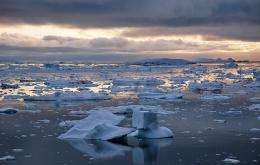
Ice Fjord of Ilulissat in Greenland. There is no "tipping point" beyond which climate change will inevitably push the Arctic ice cap into terminal melt off, according to a study released Wednesday.
There is no "tipping point" beyond which climate change will inevitably push the Arctic ice cap into terminal melt off, according to a study released Wednesday.
The northern polar cap has shrunk between 15 and 20 percent over the last 30 years, unleashing concern that on current trends -- with regional temperature increases twice or triple the global average -- it could disappear entirely during the summer months by century's end.
One of the factors in this calculation is a so-called positive feedback, in which a reduced area of floating ice helps to stoke global warming.
As ice cover recedes decade by decade, more of the Sun's radiative force is absorbed by dark-blue sea rather than bounced back into space by reflective ice and snow.
But a new study published in the British science journal Nature shows that there is nothing inevitable about this process, and that it can be halted or even reversed.
"There is no 'tipping point' that would result in unstoppable loss of summer sea ice when greenhouse gas-driven warming rose above a certain threshold," said Steven Amstrup, a professor at the University of Washington and lead author of the study.
Up to now, many scientists worried that there was an as yet unidentified temperature threshold which, once passed, would doom the ice cap.
But the study, based on computer models, indicates that if annual emissions of greenhouse gases are substantially reduced over the next two decades, an initial phase of rapid ice loss would be followed by a period of stability and, eventually, partial recovery.
If so, that could mean a reprieve for polar bears, which use floating ice shelves as a staging areas for stalking ringed and bearded seals, their preferred food.
Already today, many of the majestic predators are teetering on the edge of starvation because the ice melts sooner in spring and forms later in autumn, shortening their hunting season.
The new research "offers a very promising, hopeful message," said co-author and University of Washington professor Cecilia Blitz.
"But it's also an incentive for mitigating greenhouse gas emissions," she said in a statement.
In earlier research, Amstrup and colleagues had calculated that only a third of the world's estimated 22,000 polar bears would still be around by 2050, and that even these survivors could eventually disappear.
In 2008, Washington listed polar bears under the Endangered Species Act.
Earlier this week, more than 150 biologists and climate scientists called in an open letter on US President Barack Obama to step up action to save the Arctic's top predator.
The US Department of the Interior faces a court-imposed deadline next week on whether polar bears should continue to be classified merely as "threatened" or given maximum protection under US law as "endangered."
And a separate study also published in Nature Wednesday warned that melting ice was pushing Arctic mammals to breed with cousin species, in a trend that could be pushing the polar bear and other iconic animals towards extinction.
(c) 2010 AFP
-
From lemons to lemonade: Reaction uses carbon dioxide to make carbon-based semiconductor,
28 comments
-
Thioridazine kills cancer stem cells in human while avoiding toxic side-effects of conventional cancer treatments,
3 comments
-
SpaceX private rocket blasts off for space station (Update),
41 comments
-
Climate scientists say they have solved riddle of rising sea,
30 comments
-
Scotland passes turbine test to harness tidal power,
40 comments
-
More human population = greater mass?
17 hours ago
-
Conversion from aircraft bearing to normal degrees
May 23, 2012
-
Interpretation/Analysis of the Lab results(HEPA filter)
May 22, 2012
-
Has anyone here attended the The Urbino Summer School in Paleoclimatology?
May 22, 2012
-
Earthquakes: Mag 6 N. Italy and Mag 5.6 W. Bulgaria
May 21, 2012
-
determining time frame for most recent geological layers
May 17, 2012
- More from Physics Forums - Earth
More news stories
Dragon arrives at space station in historic 1st (Update 2)
The privately bankrolled Dragon capsule made a historic arrival at the International Space Station on Friday, triumphantly captured by astronauts wielding a giant robot arm.
Space & Earth / Space Exploration
18 hours ago |
5 / 5 (8) |
11
Dragon makes history with space station docking
The private company SpaceX made history Friday with the docking of its Dragon capsule to the International Space Station, the most impressive feat yet in turning routine spaceflight over to the commercial ...
Space & Earth / Space Exploration
11 hours ago |
4.8 / 5 (6) |
0
Aliens don't want to eat us, says former SETI director
Alien life probably isnt interested in having us for dinner, enslaving us or laying eggs in our bellies, according to a recent statement by former SETI director Jill Tarter.
Space & Earth / Space Exploration
19 hours ago |
4.8 / 5 (10) |
24
SKA super telescope to be built in Australia, South Africa (Update 2)
A long-running joust to host a radio telescope that would give mankind its farthest peek into the Universe ended on Friday with a Solomon-like judgement to split the site between Australia and South Africa.
19 hours ago |
5 / 5 (5) |
2
NASA sees Hurricane Bud threaten western Mexico's coast
NASA satellites are providing rainfall, temperature, pressure, visible and infrared data to forecasters as Hurricane Bud is expected to make a quick landfall in western Mexico this weekend before turning back ...
Space & Earth / Earth Sciences
13 hours ago |
not rated yet |
0
Of mice and mental models: Neuroscientific implications of risk-optimized behavior in the mouse
(Medical Xpress) -- Regardless of an organism’s biological complexity, every encephalized animal continuously makes under-informed behavioral choices that can have serious consequences. Despite its ubiquity, ...
Landmark calculation clears the way to answering how matter is formed
(Phys.org) -- An international collaboration of scientists, including Thomas Blum, associate professor of physics, is reporting in landmark detail the decay process of a subatomic particle called a kaon ...
High-speed method to aid search for solar energy storage catalysts
Eons ago, nature solved the problem of converting solar energy to fuels by inventing the process of photosynthesis.
It's in the genes: Research pinpoints how plants know when to flower
Scientists believe they've pinpointed the last crucial piece of the 80-year-old puzzle of how plants "know" when to flower.
Researchers solve structure of human protein critical for silencing genes
In a study published in the journal Cell on May 24, Cold Spring Harbor Laboratory (CSHL) scientists describe the three-dimensional atomic structure of a human protein bound to a piece of RNA that "guides" the pr ...
MIT researchers devise new means to synchronize a group of robots (w/ Video)
(Phys.org) -- For several years, roboticists have been working out ways to get a group of robots to perform synchronized activities as demonstrated most often in dance routines. Its not just about trying ...
Dec 15, 2010
Rank: 3 / 5 (6)
Dec 15, 2010
Rank: 4 / 5 (2)
Dec 15, 2010
Rank: 4.3 / 5 (4)
GOOD LUCK! I'll bet dollars to donuts that the increase isn't even halted.
Dec 15, 2010
Rank: 1.6 / 5 (7)
Dec 16, 2010
Rank: 4.5 / 5 (4)
I don't really like polar bears though. They are too tough, even when you slow cook them. Oh relax, I was kidding. I've only eaten black bears. Imagine having the very last polar bear rug, that would be great!
Seriously though. A little critical thinking, if you don't mind. Can you think of any reason besides caring about God's creatures (lol) that someone might want to get polar bears listed as "endangered" rather than "threatened"? If they want polar bears reclasified, shouldn't they be talking about polar bear population numbers? Why aren't there any numbers like that here? Can you think of any reason that they might want to establish a strong link between polar bears, extinctions, and global warming? Think EPA, lawyers, and money and you'll be on the right track.
Dec 17, 2010
Rank: 5 / 5 (3)
The above comments that suggest polar bear numbers are increasing are baseless as far as I can find. Those statements are only based on "reports of increased sightings by locals" not on actual tagging, tracking, and weight measurements.
On the other hand, it's probably a little misleading to say that polar bears will go extinct. It's more likely that they will increasingly interbreed with brown bears and kodiak bears until the species re-mix and become a single species again. That happens all the time with nich species. They come and go all the time. I'm not saying that's good, but it's not the end of the world.
unless you're a polar bear.
Dec 17, 2010
Rank: 5 / 5 (3)
No, it's actually quite convenient. It simply means that the melt could be seasonal, driven by man, driven by factors other than man, and isn't a permanent or catastrophic situation.
If this study stands, we can all be relieved that there isn't a point of no return in regards to sea ice. GS is rationally skeptical, some others on this site on both sides of the discussion should adopt a more similar stance.
I think AGCC is happening, I'm skeptical of some of the statements aligned with the theory. GS thinks AGCC is happening, he's skeptical of some of the statements aligned with the theory.
We hold rather different viewpoints on what we should do about it based on where our skepticism lies.
Spend your time reading rather than decrying others.
Dec 23, 2010
Rank: not rated yet
And even then, his model shows that the ice caps only recover to 50%. I'm not sure anyone can call that "recovery." Not the Dutch, anyway.
We can -- possibly -- avoid a tipping point, but the point of the paper is that action must be taken now.