Taming thermonuclear plasma with a snowflake
November 8, 2010

Taming thermonuclear plasma with a snowflake

Enlarge

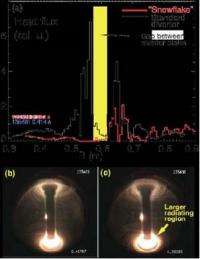
These images reveal the effect of the novel snowflake diverter, showing (a) the comparison of heat flux profiles in the "snowflake" and standard divertor configurations; (b) a plasma TV image of the standard divertor discharge; (c) a plasma TV image of the "snowflake" divertor discharge. Credit: V. Soukhanovskii, Lawrence Livermore National Laboratory

Physicists working on the National Spherical Torus Experiment (NSTX) at the Princeton Plasma Physics Laboratory are now one step closer to solving one of the grand challenges of magnetic fusion research -- how to reduce the effect that the hot plasma has on fusion machine walls (or how to tame the plasma-material interface).

Some heat from the hot plasma core of a fusion energy device escapes the plasma and can interact with reactor vessel walls. This not only erodes the walls and other components, but also contaminates the plasma -- all challenges for practical fusion. One method to protect machine walls involves divertors, chambers outside the plasma into which the plasma heat exhaust (and impurities) flow. A new divertor concept, called the "snowflake," has been shown to significantly reduce the interaction between hot plasma and the cold walls surrounding it.

Strong magnetic fields shape the hot plasma in the form of a donut in a plasma reactor called a tokamak. As confined plasma particles move along magnetic field lines inside the tokamak, some particles and heat escape because of instabilities in the plasma. Surrounding the hot plasma is a colder plasma layer, the scrape-off layer, which forms the plasma-material interface. In this layer, escaped particles and heat flow along an "open" magnetic field line to a separate part of the vessel and enter a "divertor chamber." If the plasma striking the divertor surface is too hot, melting of the plasma-facing components and loss of coolant can occur. Under such undesirable conditions, the plasma-facing component lifetime would also be an issue, as they would tend to wear off too quickly.

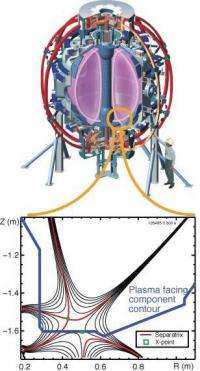
While the conventional magnetic X-point divertor concept has existed for three decades, a very recent theoretical idea and supporting calculations by Dr. D.D. Ryutov from Lawrence Livermore National Laboratory have indicated that a novel magnetic divertor -- the "snowflake divertor" -- would have much improved heat handling characteristics for the plasma-material interface. The name is derived from the appearance of forming this novel magnetic interface.
Taming thermonuclear plasma with a snowflake
Enlarge

This is a "snowflake" divertor -- a novel plasma-material interface is realized in the National Spherical Torus Experiment. Credit: V. Soukhanovskii, Lawrence Livermore National Laboratory

This magnetic configuration was recently realized in NSTX and fully confirmed the theoretical predictions. The snowflake divertor configuration was created by using only two or three existing magnetic coils. This achievement is an important result for future tokamak reactors that will operate with few magnetic coils. Because the snowflake divertor configuration flares the scrape-off layer at the divertor surface, the peak heat load is considerably reduced, as was confirmed by the divertor heat flux on NSTX. The plasma in the snowflake divertor, instead of heating the divertor surface on impact, radiated the away, cooled down and did not erode the plasma-facing components as much, thus extending their lifetime. Plasma TV images show more divertor radiation in the snowflake divertor plasmas in comparison with the standard plasmas. Importantly, the snowflake divertor did not have an impact on the high performance and confinement of the high-temperature core plasma, and even reduced the impurity contamination level of the main .

These highly encouraging results provide further support for the snowflake divertor as a viable plasma-material interface for future tokamak devices and for fusion development applications.

Provided by American Physical Society

4.8 /5 (20 votes)  

Filter


Move the slider to adjust rank threshold, so that you can hide some of the comments.


Display comments: newest first

wwqq
Nov 08, 2010

Rank: 4.4 / 5 (8)
Before the usual bunch of whiners come out in full force, I'd like to note that the fusion triple product for tokamaks has doubled every ~2 years since the T3 tokamak in 1968.

That's Moore's law-like improvement in performance. This progress is from the slow, gradual accumulation of improvements like this one.
maxcypher
Nov 08, 2010

Rank: 3.2 / 5 (5)
Let's see if I can anticipate the whiners: Fusion is one of the cleaner power sources, so it must be part of the freedom-hating, Green, Eco-terrorist, Global Conspiracists who are propagating the Global Warming Myth in order to scare Real Americans into reducing their God Given Right to consume as much unneeded goods as they can possibly jam down their obese gullets. How'd I do? Did I get that right?
Going
Nov 08, 2010

Rank: not rated yet
I believe eventually fusion power will be achieved and it will transform or economy.

One quibble why is it necessary for us to know that images were viewed on a plasma TV? Surely the author means TV images of the plasma.
Shootist
Nov 08, 2010

Rank: not rated yet
Let's see if I can anticipate the whiners: Fusion is one of the cleaner power sources, so it must be part of the freedom-hating, Green, Eco-terrorist, Global Conspiracists who are propagating the Global Warming Myth in order to scare Real Americans into reducing their God Given Right to consume as much unneeded goods as they can possibly jam down their obese gullets. How'd I do? Did I get that right?


No silly, fusion is nukler, and the green hippies have always hated nukler.

Which means, fusion (20 years from now, this time, for sure) is an acceptable power source. Along with fission, coal, petroleum and orbiting solar power plants.

Tokamaks are a technological dead end. Bussard's polywell, FTW.
trantor
Nov 08, 2010

Rank: not rated yet
interesting resemblance to the cusps in the Polywell...
muddy
Nov 08, 2010

Rank: not rated yet
Some are starting to realize what it took decades for Bussard to understand: it's all about the geometry.
Husky
Nov 08, 2010

Rank: not rated yet
Whats next, will they "discover" that just like WB-8 it is a good idea to run in pulsed plasma mode?
LimitlessMinds
Nov 09, 2010

Rank: not rated yet

One quibble why is it necessary for us to know that images were viewed on a plasma TV? Surely the author means TV images of the plasma.


plasma TV refers to the method in which the image was created
Ravenrant
Nov 14, 2010

Rank: not rated yet
I am all for green power and if it takes nuclear power to stop global warming because we are too stupid and religious to halt the true cause of global warming, overpopulation, than so be it.

However, fusion power is still going to create radioactive byproducts, in fact the same ones that regular nuclear power creates. Hopefully it doesn't create a spent fuel problem but current reactors and fusion reactors will make a lot of the metal in the reactor radioactive with huge half-lives and we will still be stuck with a radioactive mess to clean up which will only grow over time. I have doubts if even fusion power is a long term solution.

We ARE OVERPOPULATED and if we were intelligently designed why weren't we created with the innate ability to control our population by some means other than war and starvation?
ACTS1038
Nov 21, 2010

Rank: 1 / 5 (1)
Responding to Ravenrant's "We ARE OVERPOPULATED and if we were intelligently designed why weren't we created with the innate ability to control our population by some means other than war and starvation?"

It appears that the rate of population along with technical know-how is in synch for space-exploration and colonization. However, the collective choices of greed and control of this world has and continues to suppress the social and economic system into an inward diversification of resource cannibalism. And that's the why we have war and starvation. The obvious alternative is the resource of space-exploration and colonization.

We are created with the innate ability to choose Life or Death.
SkillyJr
Dec 17, 2010

Rank: not rated yet
i'm all for finally getting fusion power into the mainstream and being used as a primary power source, but i have to wonder: how long until someone weaponizes it? with every new technology that houses this much power, it's only a matter of time.
Rank 4.8 /5 (20 votes)
Relevant PhysicsForums posts
  • Water under pressure and temperature effects
    created2 hours ago
  • Flow, different liquid, pressure
    created2 hours ago
  • Dimensions and Degrees of Freedom
    created3 hours ago
  • Rotational Inertia of a disc
    created4 hours ago
  • How does B=μH really work?
    created4 hours ago
  • I need help with understanding of Inertia of a slender rod and plate?
    created7 hours ago
  • More from Physics Forums - General Physics

More news stories

Landmark calculation clears the way to answering how matter is formed

(Phys.org) -- An international collaboration of scientists, including Thomas Blum, associate professor of physics, is reporting in landmark detail the decay process of a subatomic particle called a kaon – ...

Physics / General Physics

created 15 hours ago | popularity 4.8 / 5 (11) | comments 26 | with audio podcast

Is a classical electrodynamics law incompatible with special relativity?

(Phys.org) -- The laws of classical electromagnetism that were developed in the 19th century are the same laws that scientists use today. They include Maxwell’s four equations along with the Lorentz la ...

Physics / General Physics

created May 24, 2012 | popularity 5 / 5 (13) | comments 30 | with audio podcast feature

Lying in wait for WIMPs: Researchers seek to dramatically increase sensitivity of Large Underground Xenon detector

Although it's invisible, dark matter accounts for at least 80 percent of the matter in the universe. No one knows what it is, but most scientists would bet on weakly interacting massive particles, or WIMPs.

Physics / General Physics

created May 23, 2012 | popularity 4 / 5 (5) | comments 14 | with audio podcast

Hall effect at the speed of light: How can you demonstrate relativistic effects with your mobile phone?

The relativistic Hall effect describing objects rotating at speeds comparable with the speed of light has been reported.

Physics / General Physics

created May 21, 2012 | popularity 4.3 / 5 (3) | comments 8

Cloak of invisibility: Engineers use plasmonics to create an invisible photodetector

A team of engineers at Stanford and the University of Pennsylvania has for the first time used "plasmonic cloaking" to create a device that can see without being seen - an invisible machine that detects light. It is the first ...

Physics / General Physics

created May 21, 2012 | popularity 4.8 / 5 (16) | comments 7 | with audio podcast


Of mice and mental models: Neuroscientific implications of risk-optimized behavior in the mouse

(Medical Xpress) -- Regardless of an organism’s biological complexity, every encephalized animal continuously makes under-informed behavioral choices that can have serious consequences. Despite its ubiquity, ...

Dragon arrives at space station in historic 1st (Update 2)

The privately bankrolled Dragon capsule made a historic arrival at the International Space Station on Friday, triumphantly captured by astronauts wielding a giant robot arm.

High-speed method to aid search for solar energy storage catalysts

Eons ago, nature solved the problem of converting solar energy to fuels by inventing the process of photosynthesis.

It's in the genes: Research pinpoints how plants know when to flower

Scientists believe they've pinpointed the last crucial piece of the 80-year-old puzzle of how plants "know" when to flower.

Researchers solve structure of human protein critical for silencing genes

In a study published in the journal Cell on May 24, Cold Spring Harbor Laboratory (CSHL) scientists describe the three-dimensional atomic structure of a human protein bound to a piece of RNA that "guides" the pr ...

MIT researchers devise new means to synchronize a group of robots (w/ Video)

(Phys.org) -- For several years, roboticists have been working out ways to get a group of robots to perform synchronized activities as demonstrated most often in dance routines. It’s not just about trying ...