Scientists find explanation for global advance of shrimp virus
November 1, 2010

Scientists find explanation for global advance of shrimp virus

Enlarge

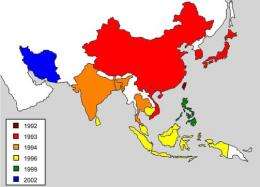
Figure: Spread of the WSSV virus in Southern Asia. The virus spread over the entire region from its source in Taiwan within several years.

White spot syndrome virus (WSSV) has a devastating impact on shrimp farming throughout the world. What makes the situation even more serious is that the virus seems to become more aggressive as the epidemic spreads, contrary to other viruses, such as flu virus, that gradually die out.

Scientists from Wageningen University, the Netherlands, reconstructed the genetic and geographical trajectory of the shrimp from the putative ancestral source, and discovered that the fitness of the virus increases over time and the genome shrinks, in a pattern similar to theoretical predictions from . These remarkable findings have just been published in the online edition of the journal .

Global shrimp production tripled over the past decade from 750,000 tonnes in the 1990s to more than three billion tonnes over the past five years, severely affecting coastal ecosystems and livelihoods. WSSV is a deadly pathogen for shrimp, and a major threat to shrimp farming for the last two decades. Over time the virus manifested itself more severely. Documented outbreaks in 1992 (China) and 1999 (Ecuador) showed a 70% reduction in local shrimp production in the years after the outbreak. The virus has since spread globally and has even been found in wild crustaceans in Europe.

Wageningen University scientists analyzed samples of the virus in from five Asian countries, then compared them to each other and published literature on WSSV from Taiwan, China, Vietnam and Thailand. This allowed the authors to clarify which genetic and fitness changes have occurred in the various virus populations since the virus was first discovered.

Deletions

The large genome of the WSSV virus has regions that vary among isolates, which mainly distinguish themselves by missing DNA fragments, or so-called deletions. By lining up a time series of virus samples, the scientists found a remarkable pattern: that the majority of these variable regions disappeared from the genome initially, but that the deletion rate decreased over time in a process that could be mathematically described. Tests with shrimp showed that the virulence of the virus increased accordingly.

Both changes appear to be evolutionary adaptations of the virus to the shrimp farming practices. Additionally the virus seems to have spread over long distances in a short timeframe, which points to transportation of infected shrimps as the major factor. Preventing the virus from spreading is a major area of improvement in combating future virus outbreaks in shrimp production systems. Understanding the epidemiology of WSSV at different temporal and spatial scales should lead to further control and containment of the disease.

Provided by Wageningen University

Filter


Move the slider to adjust rank threshold, so that you can hide some of the comments.


Display comments: newest first

rgwalther
Nov 01, 2010

Rank: not rated yet
Three billion tonnes would equate to about a 1000 pounds per person on the planet. Say so long to hunger.
Royale
Nov 01, 2010

Rank: not rated yet
they do use shrimp in catfood, dogfood, fish food, etc.. we fatten our fish while people starve.. comforting, eh?
Rank 4 /5 (2 votes)
Relevant PhysicsForums posts

More news stories

It's in the genes: Research pinpoints how plants know when to flower

Scientists believe they've pinpointed the last crucial piece of the 80-year-old puzzle of how plants "know" when to flower.

Biology / Biotechnology

created 8 hours ago | popularity 4 / 5 (5) | comments 1 | with audio podcast

Researchers solve structure of human protein critical for silencing genes

In a study published in the journal Cell on May 24, Cold Spring Harbor Laboratory (CSHL) scientists describe the three-dimensional atomic structure of a human protein bound to a piece of RNA that "guides" the pr ...

Biology / Cell & Microbiology

created 9 hours ago | popularity 5 / 5 (4) | comments 0 | with audio podcast

Study uncovers secret to speedy burrowing by razor clams

(Phys.org) -- If you look at a razor burrowing clam sitting in a bucket, you’d never guess that it could burrow itself down into the soil, much less do it with any speed. Razor clams look like fat straws, ...

Biology / Plants & Animals

created 18 hours ago | popularity not rated yet | comments 3 | with audio podcast report

Copy of the genetic makeup travels in a protein suitcase

Scientists from the Institute for Physical and Theoretical Chemistry at the University of Bonn have succeeded for the first time in the real time filming of the transport of an important information carrier in biological ...

Biology / Cell & Microbiology

created 14 hours ago | popularity not rated yet | comments 0 | with audio podcast

'Transformer' protein makes different sized transport pods

These spheres may look almost identical, but subtle differences between them revealed a molecular version of the robots from Transformers. Each sphere is a vesicle, a pod that cells use to transport materials ...

Biology / Cell & Microbiology

created 15 hours ago | popularity not rated yet | comments 0


Of mice and mental models: Neuroscientific implications of risk-optimized behavior in the mouse

(Medical Xpress) -- Regardless of an organism’s biological complexity, every encephalized animal continuously makes under-informed behavioral choices that can have serious consequences. Despite its ubiquity, ...

Dragon arrives at space station in historic 1st (Update 2)

The privately bankrolled Dragon capsule made a historic arrival at the International Space Station on Friday, triumphantly captured by astronauts wielding a giant robot arm.

Landmark calculation clears the way to answering how matter is formed

(Phys.org) -- An international collaboration of scientists, including Thomas Blum, associate professor of physics, is reporting in landmark detail the decay process of a subatomic particle called a kaon – ...

High-speed method to aid search for solar energy storage catalysts

Eons ago, nature solved the problem of converting solar energy to fuels by inventing the process of photosynthesis.

MIT researchers devise new means to synchronize a group of robots (w/ Video)

(Phys.org) -- For several years, roboticists have been working out ways to get a group of robots to perform synchronized activities as demonstrated most often in dance routines. It’s not just about trying ...

Researchers demonstrate possible primitive mechanism of chemical info self-replication

(Phys.org) -- When scientists think about the replication of information in chemistry, they usually have in mind something akin to what happens in living organisms when DNA gets copied: a double-stranded molecule ...