The incredible impact of stars on culture
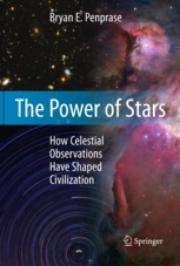
This is the cover of "The Power of Stars: How Celestial Observations Have Shaped Civilization." Credit: Springer / Heidelberg
For Hawaiian navigators, the star Sirius was "Hokuho'okelewa'a," meaning "star to guide canoe." Traditional Aboriginal Australians looked at the Magellanic Clouds and saw distant campfires in the sky.
In every culture, from prehistory to the modern day, the stars have played a key role in inspiring and shaping human efforts to understand and master the universe we live in. In a newly published book, The Power of Stars: How Celestial Observations Have Shaped Civilization, Bryan Penprase traces the cultural roots of modern astronomy through the various cosmologies, mythologies, calendaring systems, monuments and theories with which people around the world have connected the heavens to their own lives.
"In these pages," Penprase says in the opening section of the book, "we will explore the many ways in which humans throughout time have responded to the sky. Sometimes they responded with fear, sometimes with great artistry and other times with great rationality. Each culture of the world for thousands of years viewed the same stars and planets we can observe on any clear night. And the power of the night sky, filled with shimmering stars, has left its mark on human civilization."
The book ranges around the globe from the ancient Babylonians to the Incas, from Greek myths to Australian creation stories, from Mayan calendars to the Chinese Zodiac, and from the Egyptian pyramids to such modern celestial structures as the Rodin Crater Project of artist James Turrell, concluding with a brief history of the modern scientific understanding of the universe. The book also includes more than 200 images.
Penprase has been a member of the Pomona College (USA) faculty since 1993. He received his Ph.D. in astronomy and astrophysics from the University of Chicago. Penprase's research in astronomy and astrophysics has taken him around the world. He is currently a member of an international team conducting the largest study ever of near-Earth asteroids. The Power of Stars is his first book.
Provided by Springer
-
From lemons to lemonade: Reaction uses carbon dioxide to make carbon-based semiconductor,
28 comments
-
Every black hole contains a new universe: A physicist presents a solution to present-day cosmic mysteries,
216 comments
-
New silicon memory chip developed,
16 comments
-
Thioridazine kills cancer stem cells in human while avoiding toxic side-effects of conventional cancer treatments,
3 comments
-
SpaceX private rocket blasts off for space station (Update),
41 comments
-
Consumption rivalry
5 hours ago
-
Bilateral trade between all countries
May 24, 2012
-
Is the economic foundation of social media in jeopardy?
May 20, 2012
-
Psychology: Rosenthal and Hawthorne Effect
May 15, 2012
-
Is GDP and National Income the Same Thing?
May 13, 2012
-
Difference between hourly wage and real GDP per hour worked?
May 12, 2012
- More from Physics Forums - Social Sciences
More news stories
Math predicts size of clot-forming cells
UC Davis mathematicians have helped biologists figure out why platelets, the cells that form blood clots, are the size and shape that they are. Because platelets are important both for healing wounds and in strokes and other ...
6 hours ago |
not rated yet |
0
|
Oldest Jewish archaeological evidence on the Iberian Peninsula
German archaeologists of the Friedrich Schiller University Jena found one of the oldest archaeological evidence so far of Jewish Culture on the Iberian Peninsula at an excavation site in the south of Portugal, ...
Other Sciences / Archaeology & Fossils
9 hours ago |
4.3 / 5 (4) |
12
Dinosaur with tiny arms unearthed in Argentina
Argentine experts have discovered the near-complete remains of a new species of Jurassic-era dinosaur that stood on its rear legs and had tiny arms, according to a leading paleontologist.
Other Sciences / Archaeology & Fossils
18 hours ago |
5 / 5 (2) |
0
Earliest musical instruments in Europe 40,000 years ago
The first modern humans in Europe were playing musical instruments and showing artistic creativity as early as 40,000 years ago, according to new research from Oxford and Tübingen universities.
Other Sciences / Archaeology & Fossils
12 hours ago |
5 / 5 (3) |
1
Talking works: UB professor develops method to analyze creative problem solving
(Phys.org) -- Talk -- if it's the right kind -- can increase creativity, leading students to create useful, new ideas that solve problems, a University at Buffalo professor has found by using a statistical tool that he invented.
Other Sciences / Social Sciences
15 hours ago |
not rated yet |
0
It's in the genes: Research pinpoints how plants know when to flower
Scientists believe they've pinpointed the last crucial piece of the 80-year-old puzzle of how plants "know" when to flower.
High-speed method to aid search for solar energy storage catalysts
Eons ago, nature solved the problem of converting solar energy to fuels by inventing the process of photosynthesis.
Researchers solve structure of human protein critical for silencing genes
In a study published in the journal Cell on May 24, Cold Spring Harbor Laboratory (CSHL) scientists describe the three-dimensional atomic structure of a human protein bound to a piece of RNA that "guides" the pr ...
Of mice and mental models: Neuroscientific implications of risk-optimized behavior in the mouse
(Medical Xpress) -- Regardless of an organism’s biological complexity, every encephalized animal continuously makes under-informed behavioral choices that can have serious consequences. Despite its ubiquity, ...
Dragon arrives at space station in historic 1st (Update 2)
The privately bankrolled Dragon capsule made a historic arrival at the International Space Station on Friday, triumphantly captured by astronauts wielding a giant robot arm.
Landmark calculation clears the way to answering how matter is formed
(Phys.org) -- An international collaboration of scientists, including Thomas Blum, associate professor of physics, is reporting in landmark detail the decay process of a subatomic particle called a kaon ...