Genomic fault zones come and go
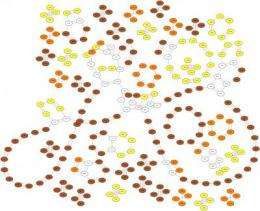
The fragile regions in mammalian genomes that are thought to play a key role in evolution go through a "birth and death" process, according to new bioinformatics research performed at the University of California, San Diego. The new work, published in the journal Genome Biology on November 30, could help researchers identify the current fragile regions in the human genome – information that may reveal how the human genome will evolve in the future.
"The genomic architecture of every species on Earth changes on the evolutionary time scale and humans are not an exception. What will be the next big change in the human genome remains unknown, but our approach could be useful in determining where in the human genome those changes may occur," said Pavel Pevzner, a UC San Diego computer science professor and an author on the new study. Pevzner studies genomes and genome evolution from a computational perspective in the Department of Computer Science and Engineering at the UC San Diego Jacobs School of Engineering.
The fragile regions of genomes are prone to "genomic earthquakes" that can trigger chromosome rearrangements, disrupt genes, alter gene regulation and otherwise play an important role in genome evolution and the emergence of new species. For example, humans have 23 chromosomes while some other apes have 24 chromosomes, a consequence of a genome rearrangement that fused two chromosomes in our ape ancestor into human chromosome 2.
This work was performed by Pevzner and Max Alekseyev – a computer scientist who recently finished his Ph.D. in the Department of Computer Science and Engineering at the UC San Diego Jacobs School of Engineering. Alekseyev is now a computer science professor at the University of South Carolina.
Turnover Fragile Breakage Model
"The main conclusion of the new paper is that these fragile regions are moving," said Pevzner.
In 2003, Pevzner and UC San Diego mathematics professor Glen Tesler published results claiming that genomes have "fault zones" or genomic regions that are more prone to rearrangements than other regions. Their "Fragile Breakage Model" countered the then largely accepted "Random Breakage Model" – which implies that there are no rearrangement hotspots in mammalian genomes. While the Fragile Breakage Model has been supported by many studies in the last seven years, the precise locations of fragile regions in the human genome remain elusive.
The new work published in Genome Biology offers an update to the Fragile Breakage Model called the "Turnover Fragile Breakage Model." The findings demonstrate that the fragile regions undergo a birth and death process over evolutionary timescales and provide a clue to where the fragile regions in the human genome are located.
Do the Math: Find Fragile Regions
Finding the fragile regions within genomes is akin to looking at a mixed up deck of cards and trying to determine how many times it has been shuffled.
Looking at a genome, you may identify breaks, but to say it is a fragile region, you have to know that breaks occurred more than once at the same genomic position. "We are figuring out which regions underwent multiple genome earthquakes by analyzing the present-day genomes that survived these earthquakes that happened millions of years ago. The notion of rearrangements cannot be applied to a single genome at a single point in time. It's relevant when looking at more than one genome," said Pevzner, explaining the comparative genomics approach they took.
"It was noticed that while fragile regions may be shared across different genomes, most often such shared fragile regions are found in evolutionarily close genomes. This observation led us to a conclusion that fragility of any particular genomic position may appear only for a limited amount of time. The newly proposed Turnover Fragile Breakage Model postulates that fragile regions are subject to a 'birth and death' process and thus have limited lifespan," explained Alekseyev.
The Turnover Fragile Breakage Model suggests that genome rearrangements are more likely to occur at the sites where rearrangements have recently occurred – and that these rearrangement sites change over tens of millions of years. Thus, the best clue to the current locations of fragile regions in the human genome is offered by rearrangements that happened in our closest ancestors – chimpanzee and other primates.
Pevzner is eagerly awaiting sequenced primate genomes from the Genome 10K Project. Sequencing the genomes of 10,000 vertebrate species – including 100s of primates – is bound to provide new insights on human evolutionary history and possibly even the future rearrangements in the human genome.
"The most likely future rearrangements in human genome will happen at the sites that were recently disrupted in primates," said Pevzner.
Work tied to the new Turnover Fragile Breakage Model may also be useful for understanding genome rearrangements at the level of individuals, rather than entire species. In the future, the computer scientists hope to use similar tools to look at the chromosomal rearrangements that occur within the cells of individual cancer patients over and over again in order to develop new cancer diagnostics and drugs.
More information: "Comparative Genomics Reveals Birth and Death of Fragile Regions in Mammalian Evolution," in Genome Biology, Volume 11 Issue 11, by Max A. Alekseyev et al.
Provided by University of California - San Diego


