NASA spacecraft hurtles toward active comet Hartley 2
October 18, 2010 By Dauna Coulter
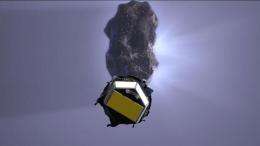
This animation shows a conceptualized view of Deep Impact's encounter with comet Tempel 1.
NASA's Deep Impact/EPOXI spacecraft is hurtling toward Comet Hartley 2 for a breathtaking 435-mile flyby on Nov. 4th. Mission scientists say all systems are go for a close encounter with one of the smallest yet most active comets they've seen.
"There are billions of comets in the solar system, but this will be only the fifth time a spacecraft has flown close enough to one to snap pictures of its nucleus," says Lori Feaga of the EPOXI science team. "This one should put on quite a show!"
Cometary orbits tend to be highly elongated; they travel far from the sun and then swing much closer. At encounter time, Hartley 2 will be nearing the sun and warming up after its cold, deep space sojourn. The ices in its nucleus will be vaporizing furiously spitting dust and spouting gaseous jets.
"Hartley 2's nucleus is small, less than a mile in diameter," says Feaga. "But its surface offgasses at a higher rate than nuclei we've seen before. We expect more jets and outbursts from this one."
EPOXI will swoop down into the comet's bright coma the sparkling aura of debris, illuminated by the sun shrouding the nucleus. The spacecraft's cameras, taking high-resolution (7 meters per pixel at closest approach) pictures all the while, will reveal this new world in all its fizzy glory.
"We hope to see features of the comet's scarred face: craters, fractures, vents," says Sebastien Besse of the science team. "We may even be able to tell which features are spewing jets!"
The spacecraft's instruments are already trained on their speeding target.
"We're still pretty far out, so we don't yet see a nucleus," explains Besse. "But our daily observations with the spectrometer and cameras are already helping us identify the species and amounts of gases in the coma and learn how they evolve over time as we approach."
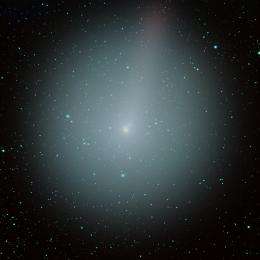
Comet Hartley 2, photographed on Oct. 13 by Science@NASA reader Nick Howes using the 2-meter Faulkes North Telescope in Hawaii.
The aim of the mission is to gather details about what the nucleus is made of and compare it to other comets. Because comets spend much of their time far from the sun, the cold preserves their composition and that composition tells a great story."Comets are left-overs from the 'construction' of our solar system," explains Besse. "When the planets formed out of the 'stuff' in the solar nebula spinning around the sun, comets weren't drawn in."
Researchers study these pristine specimens of the primal solar system to learn something about how it formed, and how it birthed a life-bearing planet like Earth.
"These flybys help us figure out what happened 4 1/2 billion years ago," says Feaga. "So far we've only seen four nucleii. We need to study more comets to learn how they differ and how they are the same. This visit will help, especially since Hartley 2 is in many ways unlike the others we've seen."
EPOXI will provide not only a birds-eye view of a new world but the best extended view of a comet in history.
"This spacecraft is built for close encounters. Its instruments and our planned observations are optimized for this kind of mission. When, as Deep Impact, it flew by Tempel 1, it turned its instruments away from the nucleus to protect them from debris blasted up by the impactor. This time we won't turn away."
The EPOXI team will be waiting at NASA's Jet Propulsion Laboratory.
"We'll start diving into the data as soon as we receive it," says Feaga. "We'll work round the clock, on our toes the whole time, waiting for the next thing to come down."
Sounds like it could be intense.
"It's already intense," says Besse. "We're getting more and more data, but at encounter we'll be flooded!"
And that will be only the beginning.
Provided by Science@NASA
-
From lemons to lemonade: Reaction uses carbon dioxide to make carbon-based semiconductor,
28 comments
-
Every black hole contains a new universe: A physicist presents a solution to present-day cosmic mysteries,
214 comments
-
New silicon memory chip developed,
16 comments
-
Computing experts unveil superefficient 'inexact' chip,
45 comments
-
SpaceX private rocket blasts off for space station (Update),
41 comments
-
Math behind Theoretical Physics
22 hours ago
-
Do we know whats at the center of galaxies yet?
23 hours ago
-
Structure of the Milky Way?
May 20, 2012
-
What would it take to terraform Pluto and Charon?
May 19, 2012
-
Whats is volume of mass at the centre of the sun
May 19, 2012
-
Galaxies moving faster than the speed of light?
May 18, 2012
- More from Physics Forums - General Astronomy
More news stories
Organic carbon from Mars, but not biological
Molecules containing large chains of carbon and hydrogen--the building blocks of all life on Earth--have been the targets of missions to Mars from Viking to the present day. While these molecules have previously ...
Space & Earth / Space Exploration
8 hours ago |
3.5 / 5 (2) |
0
|
Asteroid nudged by sunlight: Most precise measurement of Yarkovsky effect
Scientists on NASA's asteroid sample return mission, Origins, Spectral Interpretation, Resource Identification, Security, Regolith Explorer (OSIRIS-REx), have measured the orbit of their destination asteroid, ...
Space & Earth / Space Exploration
4 hours ago |
4.8 / 5 (5) |
0
|
New mapping of Mars shows western Medusae Fossae formation older than once thought
(Phys.org) -- Recent geologic mapping of the Medusae Fossae Formation on Marsan intensely eroded deposit near the northern edge of the cratered highlandshas revealed a wider distribution of its ...
Space & Earth / Space Exploration
5 hours ago |
not rated yet |
0
|
Autopsy of a eruption: Linking crystal growth to volcano seismicity
A forensic approach that links changes deep below a volcano to signals at the surface is described by scientists from the University of Bristol in a paper published today in Science. The research could ultima ...
Space & Earth / Earth Sciences
8 hours ago |
4 / 5 (1) |
0
|
Tiny planet-finding mirrors borrow from Webb Telescope playbook
NASA's next flagship mission the James Webb Space Telescope will carry the largest primary mirror ever deployed. This segmented behemoth will unfold to 21.3 feet in diameter once the observatory ...
Space & Earth / Space Exploration
4 hours ago |
3 / 5 (1) |
0
Is a classical electrodynamics law incompatible with special relativity?
(Phys.org) -- The laws of classical electromagnetism that were developed in the 19th century are the same laws that scientists use today. They include Maxwell’s four equations along with the Lorentz la ...
HyperSolar shows dirty water no barrier to power world
(Phys.org) -- The Santa Barbara, California, company, HyperSolar, is set to transparently share the ups and downs of its research experiences toward the companys ultimate vision, successfully producing ...
In nanorod crystal growth, nanoparticles seen as artificial atoms
In the growth of crystals, do nanoparticles act as "artificial atoms" forming molecular-type building blocks that can assemble into complex structures? This is the contention of a major but controversial theory ...
First direct observation of oriented attachment in nanocrystal growth
Berkeley Lab researchers have reported the first direct observation of nanoparticles undergoing oriented attachment, the critical step in biomineralization and the growth of nanocrystals. A better understanding ...
Global warming winner: Once rare butterfly thrives
(AP) -- Global warming is rescuing the once-rare brown Argus butterfly, scientists say.
Gene discovery points towards non-hormonal male contraceptive
A new type of male contraceptive could be created thanks to the discovery of a key gene essential for sperm development.
