Haiti fault capable of another big quake: study
October 24, 2010

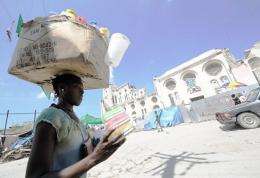
A Haitian vendor sells goods on October 14, near the destroyed Port-au-Prince Cathedral

Enlarge

A Haitian vendor sells goods on October 14, near the destroyed Port-au-Prince Cathedral. The January 12 earthquake in Haiti failed to release all the tension in a notorious seismic fault, leaving its capital exposed to the risk of another seismic disaster, US scientists reported Sunday.

The January 12 earthquake in Haiti failed to release all the tension in a notorious seismic fault, leaving its capital exposed to the risk of another seismic disaster, US scientists reported Sunday.

The magnitude 7.0 event, which killed a quarter of a million Haitians, occurred to the west of the capital Port-au-Prince.

The culprit was initially thought to be a well-known but poorly understood called the Enriquillo-Plantain Garden Zone (EPGZ), where 7.0 quakes occurred in 1751 and 1770.

The complex 270-kilometre (168-mile) -long fault runs along one of the narrow western prongs of the island of Hispaniola, which Haiti shares with the Dominican Republic.

A team of geologists led by Carole Prentice, of the US Geological Survey (USGS) at Menlo Park, California, say assumptions that the EPGZ was to blame may be wrong.

They carried out , aerial photography and boots-on-the-ground investigation to look for surface evidence of earthquakes along the fault.

They found plenty of evidence of ground rupture, uplifted land and diverted streams that must have occurred in the 18th-century shakes -- but nothing similar that could be pinned to the 2010 event.

While not unprecedented in seismology, this is highly unusual, for the January was very big and ocurred close to the surface.

Prentice's team did some computer modelling to try to explain what could have happened.

One suggestion is that the EPGZ did indeed slip, but at depth, while another is that the quake occurred on a "blind" sub-parallel structure.

Either way, the visual observations and the computer models all indicate that the January quake did not ease the nearly two and a half centuries of accumulated strain at the EPGZ's surface.

"The EPGZ remains a serious seismic hazard for , particularly for the Port-au-Prince area," warns the study, which is published online by the journal Nature Geoscience.

It raised special concern over a 110-km (65-mile) stretch that runs from Lake Miragoane in the west to Dumay in the east, tracking just south of the Haitan capital.

"These sections of the fault remain capable of generating an earthquake of up to 7.0 magnitude and, in the case of the Momance and Dumay sections, which are closer to Port-au-Prince, potentially causing stronger ground shaking in the urban area than the January 12 event."

On October 10, a separate team of geologists, also publishing in Nature Geoscience, found that the January gave only "limited" release to the EPGZ.

Calculating the pentup strain since the 18th century, they said "an earthquake larger than the 2010 is certainly possible" if the fault ruptured adjacent to Port-au-Prince.

Neither study gave any indication of when this feared earthquake could occur.

Seismologists say they are gaining more and knowledge about how earthquakes happen and are better at predicting the magnitude of some kinds of quakes.

But pinpointing, even roughly, when these events will happen remains elusive.

(c) 2010 AFP

3.7 /5 (3 votes)  

Rank 3.7 /5 (3 votes)
Relevant PhysicsForums posts

More news stories

New mapping of Mars shows western Medusae Fossae formation older than once thought

(Phys.org) -- Recent geologic mapping of the Medusae Fossae Formation on Mars—an intensely eroded deposit near the northern edge of the cratered highlands—has revealed a wider distribution of its ...

Space & Earth / Space Exploration

created 28 minutes ago | popularity not rated yet | comments 0 | with audio podcast

SpaceX readies space station rendezvous

The US company SpaceX on Thursday prepared for the climax of its Dragon capsule's landmark mission to the International Space Station with a high-stakes bid to latch on to the orbiting research lab.

Space & Earth / Space Exploration

created 1 hour ago | popularity not rated yet | comments 0

Organic carbon from Mars, but not biological

Molecules containing large chains of carbon and hydrogen--the building blocks of all life on Earth--have been the targets of missions to Mars from Viking to the present day. While these molecules have previously ...

Space & Earth / Space Exploration

created 3 hours ago | popularity not rated yet | comments 0 | with audio podcast

NASA satellites feed forecasters information as Bud becomes a hurricane

Bud has now become the first hurricane of the eastern Pacific Hurricane Season, as NASA visible and infrared satellite imagery revealed an organized structure of spiraling thunderstorms around the eye. Watches ...

Space & Earth / Earth Sciences

created 1 hour ago | popularity not rated yet | comments 0

Private supply ship flies by space station in test (Update)

The world's first private supply ship flew tantalizingly close to the International Space Station on Thursday but did not stop, completing a critical test in advance of the actual docking.

Space & Earth / Space Exploration

created 8 hours ago | popularity 4.7 / 5 (6) | comments 3


Gene discovery points towards non-hormonal male contraceptive

A new type of male contraceptive could be created thanks to the discovery of a key gene essential for sperm development.

Infections may be deadly for many dialysis patients

An infection called peritonitis commonly arises in the weeks before many dialysis patients die, according to a study appearing in an upcoming issue of the Journal of the American Society of Nephrology (JASN). The findings sugges ...

Obese patients face increased risk of kidney damage after heart surgery

Oxidative stress may put obese patients at increased risk of developing kidney damage after heart surgery, according to a study appearing in an upcoming issue of the Journal of the American Society of Nephrology (JASN). Effect ...

Is a classical electrodynamics law incompatible with special relativity?

(Phys.org) -- The laws of classical electromagnetism that were developed in the 19th century are the same laws that scientists use today. They include Maxwell’s four equations along with the Lorentz la ...

HyperSolar shows dirty water no barrier to power world

(Phys.org) -- The Santa Barbara, California, company, HyperSolar, is set to transparently share the ups and downs of its research experiences toward the company’s ultimate vision, successfully producing ...

Global warming winner: Once rare butterfly thrives

(AP) -- Global warming is rescuing the once-rare brown Argus butterfly, scientists say.