The first glow-in-the-dark animals may have been ancient corals deep in the ocean
Many animals can glow in the dark. Fireflies famously blink on summer evenings. But most animals that light up are found in the depths of the ocean.
Proceedings of the Royal Society is the parent title of two scientific journals published by the Royal Society, whereas its initial journal, Philosophical Transactions, is now devoted to special thematic issues. Originally a single journal, "Proceedings" was split into two separate journals in 1905: The two journals are currently the Royal Society s main research journals. Many celebrated names in science have published their research in Proc. R. Soc., including Paul Dirac, Werner Heisenberg, James Clerk Maxwell, Ernest Rutherford, and Erwin Schrödinger. The Proceedings started out in 1800 as the Abstracts of the Papers Printed in the Philosophical Transactions of the Royal Society of London. The Royal Society published four volumes, from 1800 to 1843. Volumes 5 and 6, which appeared from 1843 to 1854, were called Abstracts of the Papers Communicated to the Royal Society of London. Starting with volume 7, in 1854, the Proceedings first appeared under the name Proceedings of the Royal Society of London. Publication of the proceedings in this form continued to volume 75 in 1905. Starting with volume 76, the Proceedings were split into Proceedings of the Royal Society of London.

Many animals can glow in the dark. Fireflies famously blink on summer evenings. But most animals that light up are found in the depths of the ocean.
Plants & Animals
23 hours ago
0
19

Migratory birds are able to navigate and orientate with astonishing accuracy using various mechanisms, including a magnetic compass. A team led by biologists Dr. Corinna Langebrake and Prof. Dr. Miriam Liedvogel from the ...
Plants & Animals
Apr 24, 2024
0
1098

If a person has a high-quality, late-life environment, it can mitigate the negative impact caused by early-life stressors, a new study suggests. Researchers determined this human outcome after analyzing data from more than ...
Plants & Animals
Apr 24, 2024
0
0

A new study published in Proceedings of the Royal Society B: Biological Sciences sheds light on how parasites influence the intricate relationships between predator and prey populations.
Ecology
Apr 24, 2024
0
1

An international team of archaeologists, paleontologists, evolutionists and geoscientists has analyzed ancient shark fossils from the time of the dinosaurs that were recently unearthed in Mexico. In their paper published ...
Bioluminescence first evolved in animals at least 540 million years ago in a group of marine invertebrates called octocorals, according to the results of a new study from scientists with the Smithsonian's National Museum ...
Evolution
Apr 23, 2024
0
104
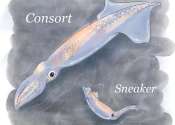
The day a male spear squid hatches determines which mating tactic he will use throughout his life, according to new research. Spear squid (Heterololigo bleekeri) that hatch earlier in the season become "consorts" that fight ...
Plants & Animals
Apr 23, 2024
0
43

Migration and reproduction are two of the most demanding events in a bird's annual cycle, so much so that the vast majority of migratory birds separate the two tasks into different times of the year.
Plants & Animals
Apr 18, 2024
0
98

Monash University ornithologists have shed light on the intricate relationship between social structure, environmental conditions, and cooperative behavior in superb fairy-wrens (Malurus cyaneus).
Plants & Animals
Apr 17, 2024
0
19
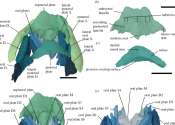
Early jawless fish were likely to have used bony projections surrounding their mouths to modify their mouth shape while they collected food.
Evolution
Apr 10, 2024
0
96
