Geophysical Research Letters is a semi-monthly peer reviewed scientific journal published by the American Geophysical Union that was established in 1974. The editor-in-chief is Eric Calais (Purdue University). The stated purpose of Geophysical Research Letters is rapid publication of conscise research reports that may significantly influence one or more American Geophysical Union disciplines. These particular geoscience disciplines are atmospheric sciences, solid earth, space sciences, ocean sciences, hydrology, land surface processes, and the cryosphere. GRL also publishes twelve invited reviews that cover advances achieved during the past two or three years. The target readership is the earth science community, the broader scientific community, and the general public. This journal is indexed in the following databases: According to the Journal Citation Reports, the journal has a 2010 impact factor of 3.505, ranking it 12th out of 165 journals in the category "Geosciences, Multidisciplinary". Geophysical Research Letters was also the 5th most cited publication on climate change between 1999 and 2009.
Collisions of coronal mass ejections can be super-elastic
Coronal mass ejections (CMEs), emissions of magnetized ionized gas from the Sun, can damage satellites and communication technology, so being able to predict where they are heading and how much energy they ...
Northern hemisphere losing last dry snow region, says study
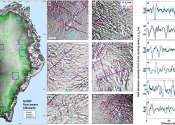
(Phys.org) —Last July, something unprecedented in the 34-year satellite record happened: 98 percent of the Greenland Ice Sheet's surface melted, compared to roughly 50 percent during an average summer. ...
Emissions from shipping making ocean more acidic, researchers report
Shipping pollution along major trade lanes can rival carbon emissions in contributing to the increased acidity of the ocean, according to a new study by an international team, including researchers from the ...
Cooling ocean temperature could buy more time for coral reefs
(Phys.org) —Limiting the amount of warming experienced by the world's oceans in the future could buy some time for tropical coral reefs, say researchers from the University of Bristol.
Western Indian Ocean earthquake and tsunami hazard potential greater than previously thought
Earthquakes similar in magnitude to the 2004 Sumatra earthquake could occur in an area beneath the Arabian Sea at the Makran subduction zone, according to recent research published in Geophysical Research Le ...
Weather forecasts on Mars
(Phys.org) —In the north of the red planet snowfalls occur with great regularity. Expeditions of Mars rovers into this region could therefore be easily planned.
Extensive Antarctic campaign finds cold bias in satellite records
Advances in satellite sensing have now made it possible to track changes in the world's most remote locations. Over the Antarctic continental interior, the vast majority of profiles of atmospheric temperature are provided ...
NASA study projects warming-driven changes in global rainfall (w/ Video)
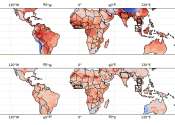
(Phys.org) —A NASA-led modeling study provides new evidence that global warming may increase the risk for extreme rainfall and drought.
Scientists detect dark lightning linked to visible lightning
(Phys.org)—Researchers have identified a burst of high-energy radiation known as 'dark lightning" immediately preceding a flash of ordinary lightning. The new finding provides observational evidence that ...
AGU: Wildfires can burn hot without ruining soil, new study finds
When scientists torched an entire 22-acre watershed in Portugal in a recent experiment, their research yielded a counterintuitive result: Large, hot fires do not necessarily beget hot, scorched soil.
Agulhas Current leakage could stabilize Atlantic overturning circulation
A major focus of concern for the coming century is understanding how the Atlantic Meridional Overturning Circulation (AMOC) will respond to the changing temperatures and wind patterns brought on by global climate change. ...
Arctic nearly free of summer sea ice during first half of 21st century
For scientists studying summer sea ice in the Arctic, it's not a question of "if" there will be nearly ice-free summers, but "when." And two scientists say that "when" is sooner than many thought—before ...
Greenhouse gases make high temps hotter in China (Update)
China, the world's largest producer of carbon dioxide, is directly feeling the man-made heat of global warming, scientists conclude in the first study to link the burning of fossil fuels to one country's ...
No link between solar activity and earthquakes
Geophysicists have disproved a long-held belief that changes in solar activity can be linked to increased earthquake activity.
New chart shows the entire topography of the Antarctic seafloor in detail for the first time
Reliable information on the depth and floor structure of the Southern Ocean has so far been available for only few coastal regions of the Antarctic. An international team of scientists under the leadership ...