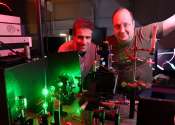
Running an LED in reverse could cool future computers

In a finding that runs counter to a common assumption in physics, researchers at the University of Michigan ran a light emitting diode (LED) with electrodes reversed in order to cool another device mere nanometers away.

Quantum microscopy study makes electrons visible in slow motion

Physicists at the University of Stuttgart under the leadership of Prof. Sebastian Loth are developing quantum microscopy which enables them for the first time to record the movement of electrons at the atomic level with both ...

The Star Wars 'superlaser' may no longer be sci-fi

In a world-leading study researchers at Macquarie University have proven a method for multiplying laser power using diamond, demonstrating that a laser similar to the Star Wars 'superlaser' may no longer remain in science ...

Lasers etch a 'perfect' solar energy absorber

The University of Rochester research lab that recently used lasers to create unsinkable metallic structures has now demonstrated how the same technology could be used to create highly efficient solar power generators.

Laser light made into a supersolid for the first time

A small international team of nanotechnologists, engineers and physicists has developed a way to force laser light into becoming a supersolid. Their paper is published in the journal Nature. The editors at Nature have published ...

page 7 from 40