New method unravels the mystery of slow electrons
Slow electrons are used in cancer therapy as well as in microelectronics. It is very hard to observe how they behave in solids. But scientists at TU Wien have made this possible.
Transport phenomena is a research area concerned with the fundamental mechanisms and coupled behavior of momentum, heat, and mass transfer in physical, chemical, and biological systems. It formulates and analyzes balance equations derived from conservation laws, typically expressed as partial differential equations such as the Navier–Stokes, energy, and species transport equations. The field emphasizes constitutive relations (e.g., Newton’s law of viscosity, Fourier’s law of heat conduction, Fick’s law of diffusion) and dimensionless analysis to characterize regimes and scaling. Transport phenomena underpins modeling, simulation, and optimization across chemical engineering, materials processing, microfluidics, energy systems, and physiological flows.

Slow electrons are used in cancer therapy as well as in microelectronics. It is very hard to observe how they behave in solids. But scientists at TU Wien have made this possible.
Condensed Matter
May 13, 2024
0
56

When an ordinary electrical conductor—such as a metal wire—is connected to a battery, the electrons in the conductor are accelerated by the electric field created by the battery. While moving, electrons frequently collide ...
Nanophysics
May 13, 2024
0
439

The natural vein structure found within leaves—which has inspired the structural design of porous materials that can maximize mass transfer—could unlock improvements in energy storage, catalysis, and sensing thanks to a new ...
Nanophysics
May 7, 2024
0
157

Spintronics is a field garnering immense attention for its range of potential advantages for conventional electronics. These include reducing power consumption, high-speed operation, non-volatility, and the potential for ...
Condensed Matter
Apr 23, 2024
0
124
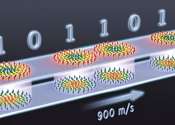
An international research team led by scientists from the CNRS has discovered that the magnetic nanobubbles known as skyrmions can be moved by electrical currents, attaining record speeds up to 900 m/s.
Condensed Matter
Apr 18, 2024
0
1102

An international research team led by the University of Göttingen has demonstrated experimentally that electrons in naturally occurring double-layer graphene move like particles without any mass, in the same way that light ...
Nanophysics
Apr 16, 2024
0
439

Proteins are vital for facilitating charge transport (CT) chain reactions, both within individual proteins and between proteins. Understanding CT in proteins is crucial for biological processes and the development of bioelectronic ...
Bio & Medicine
Apr 1, 2024
0
105

Experimental and theoretical physicists from the Würzburg Institute for Topological Insulators have observed a re-entrant quantum Hall effect in a mercury telluride device and have identified it as a signature of parity anomaly.
Condensed Matter
Mar 26, 2024
0
140

A study, published in Nature Communications and led by Prof. Liu Xinfeng from the National Center for Nanoscience and Technology (NCNST) of the Chinese Academy of Sciences (CAS), recently reported an enhancement in exciton ...
Nanophysics
Mar 15, 2024
0
91

Plant vascular circulation, ion channels, our own lymphatic network, and many energy harvesting systems rely on the transport of dissolved salt solutions through tortuous conduits. These solutions, or electrolytes, maintain ...
General Physics
Mar 4, 2024
0
57
