Page 2: Research news on Dynamics of networks

Dynamics of networks is a research area focused on the temporal evolution of networked systems, examining how node and edge states and topologies change over time and how these changes influence collective behavior. It integrates concepts from nonlinear dynamics, statistical physics, control theory, and graph theory to study processes such as synchronization, spreading phenomena, adaptive rewiring, and coevolution of structure and function. Researchers analyze stability, phase transitions, attractors, and transient behaviors in networks ranging from biological and neural systems to technological and social infrastructures, often using differential equations, stochastic processes, and computational simulations to characterize dynamical regimes and emergent phenomena.

Brain delays could be a computational advantage, researchers say

Biological components are less reliable than electrical ones, and rather than instantaneously receive the incoming signals, the signals arrive with a variety of delays. This forces the brain to cope with said delays by having ...

How to track important changes in a dynamic network

Networks can represent changing systems, like the spread of an epidemic or the growth of groups in a population of people. But the structure of these networks can change, too, as links appear or vanish over time. To better ...

Validating the low-rank hypothesis in complex systems

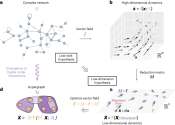
In a new study, scientists have investigated the pervasive low-rank hypothesis in complex systems, demonstrating that despite high-dimensional nonlinear dynamics, many real networks exhibit rapidly decreasing singular values, ...

page 2 from 2