Bacterium counteracts 'coffee ring effect'
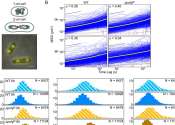
In biology, we often think of natural selection and survival of the fittest. What about survival of the luckiest? Like pioneers in search of a better life, bacteria on a surface wander around and often organize into highly ...
To infect its host, the respiratory pathogen Pseudomonas aeruginosa takes an ordinary protein usually involved in making other proteins and adds three small molecules to turn it into a key for gaining access to human cells. ...
A new study which was performed jointly at Umea University and the University of Washington in Seattle, USA, discovered that bacteria can degrade the cell membrane of bacterial competitors with enzymes that do not harm their ...
Some people may joke about living on caffeine, but scientists now have genetically engineered E. coli bacteria to do that—literally. Their report in the journal ACS Synthetic Biology describes bacteria bein ...
(Phys.org)—Rice University researchers "cured" a strain of bacteria of its ability to resist an antibiotic in an experiment that has implications for a long-standing public health crisis.
(Phys.org)—Scientists have identified the chemical 'fingerprints' given off by specific bacteria when present in the lungs, potentially allowing for a quick and simple breath test to diagnose infections such as tuberculosis.
(Phys.org)—Band-aid technology has made incremental improvements in the years since its commercial introduction in the late 1960s, the most important of which has been the incorporation ...
The relatively new field in microbiology that focuses on quorum sensing has been making strides in understanding how bacteria communicate and cooperate. Quorum sensing describes the bacterial communication between cells that ...
(Phys.org)—Infectious bacteria received a taste of their own medicine from University of Missouri researchers who used viruses to infect and kill colonies of Pseudomonas aeruginosa, common disease-causing bacteria. The vi ...
Biochemist Alejandro Heuck at the University of Massachusetts Amherst recently received a five-year, $950,000 grant from the National Institutes of Health to map the molecular structure of a needle-like tool ...
Researchers have identified the set of tools an infectious microbe uses to persuade a plant to open the windows and let the bug and all of its friends inside.
Scientists at The University of Nottingham have opened the way for more accurate research into new ways to fight dangerous bacterial infections by proving a long-held theory about how bacteria communicate ...
The superbugs have met their match. Conceived at Nanyang Technological University (NTU), it comes in the form of a coating which has a magnetic-like feature that attracts bacteria and kills them without the need for antibiotics.