A primate (pronounced /ˈprаɪmeɪt/, us dict: prī′·māt) is a member of the biological order Primates (/prаɪˈmeɪtiːz/ prī·mā′·tēz; Latin: "prime, first rank"), the group that contains lemurs, the Aye-aye, lorisids, galagos, tarsiers, monkeys, and apes, with the last category including great apes. With the exception of humans, who inhabit every continent on Earth,[a] most primates live in tropical or subtropical regions of the Americas, Africa and Asia. Primates range in size from the Pygmy Mouse Lemur weighing only 30 grams (1.1 oz) to the Mountain Gorilla weighing 200 kilograms (440 lb). According to fossil evidence, the primitive ancestors of primates may have existed in the late Cretaceous period around 65 million years ago, and the oldest known primate is the Late Paleocene Plesiadapis, c. 55–58 million years ago. Molecular clock studies suggest that the primate branch may be even older, originating in the mid-Cretaceous period around 85 mya.
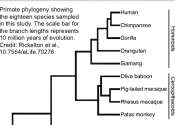
The Primates order has traditionally been divided into two main groupings: prosimians and simians. Prosimians have characteristics most like those of the earliest primates, and included the lemurs of Madagascar, lorisiforms, Aye-aye and tarsiers. Simians included the monkeys and apes. More recently, taxonomists have created the suborder Strepsirrhini, or "curly-nosed" primates, to include non-tarsier prosimians and the suborder Haplorrhini, or "dry-nosed" primates, to include tarsiers and the simians. Simians are divided into two groups: the platyrrhines ("flat nosed") or New World monkeys of South and Central America and the catarrhine ("narrow nosed") monkeys of Africa and southeastern Asia. The New World monkeys include the capuchin, howler and squirrel monkeys, and the catarrhines include the Old World monkeys (such as baboons and macaques) and the apes. Humans are the only catarrhines that have spread outside of Africa, South Asia, and East Asia, although fossil evidence shows many species once existed in Europe as well.
Considered generalist mammals, primates exhibit a wide range of characteristics. Some primates (including some great apes and baboons) do not live primarily in trees, but all species possess adaptations for climbing trees. Locomotion techniques used include leaping from tree to tree, walking on two or four limbs, knuckle-walking, and swinging between branches of trees (known as brachiation). Primates are characterized by their large brains, relative to other mammals, as well as an increased reliance on stereoscopic vision at the expense of smell, the dominant sensory system in most mammals. These features are most significant in monkeys and apes, and noticeably less so in lorises and lemurs. Three-color vision has developed in some primates. Most also have opposable thumbs and some have prehensile tails. Many species are sexually dimorphic, which means males and females have different physical traits, including body mass, canine tooth size, and coloration. Primates have slower rates of development than other similarly sized mammals, and reach maturity later but have longer lifespans. Some species live in solitude, others live in male–female pairs, and others live in groups of up to hundreds of members.