High-intensity spatial-mode steerable frequency up-converter toward on-chip integration
A study published in Opto-Electronic Science discusses high-intensity spatial-mode steerable frequency up-converter toward on-chip integration.

A study published in Opto-Electronic Science discusses high-intensity spatial-mode steerable frequency up-converter toward on-chip integration.
Optics & Photonics
May 1, 2024
0
17
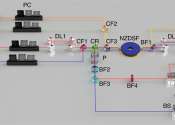
Scientists have introduced a form of quantum entanglement known as frequency-domain photon number-path entanglement. This advance in quantum physics involves an innovative tool called a frequency beam splitter, which has ...
Optics & Photonics
Apr 26, 2024
0
943
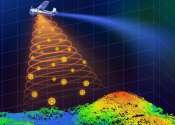
Researchers have developed a compact and lightweight single-photon airborne lidar system that can acquire high-resolution 3D images with a low-power laser. This advance could make single-photon lidar practical for air and ...
Optics & Photonics
Apr 25, 2024
0
407
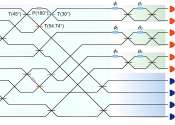
Photonic quantum computers are computational tools that leverage quantum physics and utilize particles of light (i.e., photons) as units of information processing. These computers could eventually outperform conventional ...
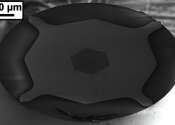
Using an ultrasensitive photonic crystal, TU/e researchers were able to detect single particles down to 50 nanometers in diameter. The new research has just been published in the journal Optica.
Nanophysics
Apr 24, 2024
0
126

Much like how electric circuits use components to control electronic signals, quantum networks rely on special components and nodes to transfer quantum information between different points, forming the foundation for building ...
Optics & Photonics
Apr 24, 2024
0
37
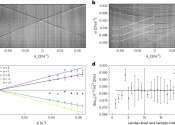
Unlike electrons, particles of light are uncharged, so they do not respond to magnetic fields. Despite this, researchers have now experimentally made light effectively "feel" a magnetic field within a complicated structure ...
Condensed Matter
Apr 24, 2024
0
70

AMOLF researchers, in collaboration with Delft University of Technology, have succeeded in bringing light waves to a halt by deforming the two-dimensional photonic crystal that contains them. The researchers show that even ...
Optics & Photonics
Apr 24, 2024
3
148

Single-photon emitters (SPEs) are akin to microscopic lightbulbs that emit only one photon (a quantum of light) at a time. These tiny structures hold immense importance for the development of quantum technology, particularly ...
Condensed Matter
Apr 23, 2024
0
125

An international collaboration of researchers, led by Philip Walther at University of Vienna, have achieved a significant breakthrough in quantum technology, with the successful demonstration of quantum interference among ...
Optics & Photonics
Apr 19, 2024
0
440
In physics, a photon is an elementary particle, the quantum of the electromagnetic field and the basic "unit" of light and all other forms of electromagnetic radiation. It is also the force carrier for the electromagnetic force. The effects of this force are easily observable at both the microscopic and macroscopic level, because the photon has no rest mass; this allows for interactions at long distances. Like all elementary particles, photons are governed by quantum mechanics and will exhibit wave-particle duality – they exhibit properties of both waves and particles. For example, a single photon may be refracted by a lens or exhibit wave interference, but also act as a particle giving a definite result when its location is measured.
The modern concept of the photon was developed gradually by Albert Einstein to explain experimental observations that did not fit the classical wave model of light. In particular, the photon model accounted for the frequency dependence of light's energy, and explained the ability of matter and radiation to be in thermal equilibrium. It also accounted for anomalous observations, including the properties of black body radiation, that other physicists, most notably Max Planck, had sought to explain using semiclassical models, in which light is still described by Maxwell's equations, but the material objects that emit and absorb light are quantized. Although these semiclassical models contributed to the development of quantum mechanics, further experiments proved Einstein's hypothesis that light itself is quantized; the quanta of light are photons.
In the modern Standard Model of particle physics, photons are described as a necessary consequence of physical laws having a certain symmetry at every point in spacetime. The intrinsic properties of photons, such as charge, mass and spin, are determined by the properties of this gauge symmetry.
The photon concept has led to momentous advances in experimental and theoretical physics, such as lasers, Bose–Einstein condensation, quantum field theory, and the probabilistic interpretation of quantum mechanics. It has been applied to photochemistry, high-resolution microscopy, and measurements of molecular distances. Recently, photons have been studied as elements of quantum computers and for sophisticated applications in optical communication such as quantum cryptography.
This text uses material from Wikipedia, licensed under CC BY-SA
