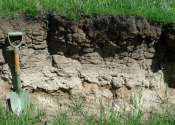
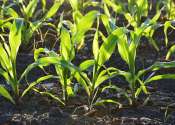
Fertilizers provide mixed benefits to soil in 50-year Kansas study
Fertilizing with inorganic nitrogen and phosphorus definitely improves crop yields, but does it also improve the soil?
(Phys.org) —In the quest to decrease the world's greenhouse gases, Cornell scientists have discovered that biochar – a charcoal-like substance – reduces the nemesis nitrous oxide from agricultural soil ...
Each time it rains, runoff carries an earthy tea steeped from leaf litter, crop residue, soil, and other organic materials into the storm drains and streams that feed Chesapeake Bay.
(Phys.org) —Scientists have uncovered one of nature's long-kept secrets—the true fate of charcoal in the world's soils. The ability to determine the fate of charcoal is critical to knowledge of the global ...
A new study which was performed jointly at Umea University and the University of Washington in Seattle, USA, discovered that bacteria can degrade the cell membrane of bacterial competitors with enzymes that do not harm their ...
(Phys.org) —Giant ancient corals off the coast of Madagascar have revealed that climate swings thousands of kilometres away in the Pacific Ocean have a major impact on rainfall variations in the Western ...
A U.S. Department of Agriculture (USDA) scientist is giving guidance to growers in Montana and the Dakotas on how grazing sheep when fields are left fallow will affect soil quality.
(AP)—Two years after the triple calamities of earthquake, tsunami and nuclear disaster ravaged Japan's northeastern Pacific coast, debris containing asbestos, lead, PCBs—and perhaps most worrying—radioactive ...
Organic rice studies have moved to the front burner with almost $1 million in federal grants to Texas A&M AgriLife Research scientists.
Ancient carbon trapped in Arctic permafrost is extremely sensitive to sunlight and, if exposed to the surface when long-frozen soils melt and collapse, can release climate-warming carbon dioxide gas into ...
(Phys.org)—Some types of carbon nanotubes used for strengthening plastics and other materials may have an adverse effect on soil microbiology and soil microbial processes, a Purdue University study shows.
Warmer temperatures due to climate change could cause soils to release additional carbon into the atmosphere, thereby enhancing climate change – but that effect diminishes over the long term, finds a new ...