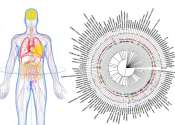
A human is a member of a species of bipedal primates in the family Hominidae (taxonomically Homo sapiens—Latin: "wise man" or "knowing man"). DNA and fossil evidence indicates that modern humans originated in east Africa about 200,000 years ago . When compared to other animals and primates, humans have a highly developed brain, capable of abstract reasoning, language, introspection and problem solving. This mental capability, combined with an erect body carriage that frees the forelimbs (arms) for manipulating objects, has allowed humans to make far greater use of tools than any other species. Humans are distributed worldwide, with significant populations inhabiting most land areas of Earth. The human population on Earth is greater than 6.7 billion, as of February 2009,
Like most higher primates, humans are social by nature. Humans are particularly adept at utilizing systems of communication—primarily spoken, gestural, and written language—for self-expression, the exchange of ideas, and organization. Humans create complex social structures composed of many cooperating and competing groups, from families to nations. Social interactions between humans have established an extremely wide variety of traditions, rituals, ethics, values, social norms, and laws, which together form the basis of human society. Humans are distinctive as a species on the Earth by having a perception of beauty and aesthetics at least to a point which results in a material culture. This, when combined with the desire for self-expression and a proportionally large brain-size, has led to innovations such as art, written language, music and science.
Humans seek to understand and influence the environment around them by trying to explain and manipulate natural phenomena through philosophy, art, science, mythology, and religion. This natural curiosity has led to the development of advanced tools and skills. Although humans are not the only species to use tools, they are unique in building fires, cooking their food, and clothing themselves; as well as using other advanced technologies. Humans pass down their skills and knowledge to the next generations and so are regarded as dependent upon culture.