Frontpage » Tag » dna strand

News tagged with dna strand

The next computer: your genes

(PhysOrg.com) -- "Human beings are more or less like a computer," Jian-Jun Shu tells PhysOrg.com. "We do computing work, and our DNA can be used in computing operations." Shu is a professor at the School of Mec ...

Physics / General Physics

created May 16, 2011 | popularity 3.2 / 5 (40) | comments 24 | with audio podcast feature

Scientists create first 3-D map of human genome

(PhysOrg.com) -- For the first time, scientists have developed a method for generating accurate three-dimensional models of the entire DNA strand of a cell, known as a genome.

Biology / Biotechnology

created Jan 04, 2012 | popularity 4.6 / 5 (21) | comments 5 | with audio podcast

Ticking of cellular clock promotes seismic changes in the chromatin landscape associated with aging

Like cats, human cells have a finite number of lives-once they divide a certain number of times (thankfully, more than nine) they change shape, slow their pace, and eventually stop dividing, a phenomenon called ...

Biology / Cell & Microbiology

created Oct 03, 2010 | popularity 4.8 / 5 (19) | comments 0 | with audio podcast

Researchers create the first artificial neural network out of DNA

Artificial intelligence has been the inspiration for countless books and movies, as well as the aspiration of countless scientists and engineers. Researchers at the California Institute of Technology (Caltech) ...

Biology / Biotechnology

created Jul 20, 2011 | popularity 4.7 / 5 (19) | comments 13 | with audio podcast

Antarctic lake home to diverse community of viruses

(PhysOrg.com) -- A study of the genetic structure of viruses in an Antarctic lake has revealed an astonishing genetic richness in the large number of viral families discovered.

Biology / Cell & Microbiology

created Nov 11, 2009 | popularity 4.9 / 5 (17) | comments 1 weblog

A $1000 genome could be reached by 2013

(PhysOrg.com) -- A new report published in the journal Nature describes the new machine created by Jonathan Rothberg of Ion Torrent Systems which uses semiconductors to decode DNA and takes them one step c ...

Biology / Biotechnology

created Jul 21, 2011 | popularity 5 / 5 (14) | comments 2 | with audio podcast report

Overturning 250 years of scientific theory: Age, repeated injury do not affect newt regeneration

(PhysOrg.com) -- Scientists have been wrong for 250 years about a fundamental aspect of tissue regeneration, according to a University of Dayton biologist who says his recent discovery is good news for humans.

Biology / Plants & Animals

created Jul 12, 2011 | popularity 4.9 / 5 (14) | comments 5 | with audio podcast

Scientists build world's first nanofluidic device with complex 3-D surfaces

(PhysOrg.com) -- Researchers at the Commerce Department's National Institute of Standards and Technology (NIST) and Cornell University have capitalized on a process for manufacturing integrated circuits at ...

Nanotechnology / Bio & Medicine

created Mar 31, 2009 | popularity 4.8 / 5 (12) | comments 0

Chemists Discover How Cells Create Stability During Critical DNA-to-RNA Information Transfers

(PhysOrg.com) -- A pair of University of Massachusetts Amherst chemists believe they have for the first time explained how the main players in transcription -- RNA polymerase, RNA (red in illustration) and ...

Chemistry / Biochemistry

created Dec 29, 2009 | popularity 4.6 / 5 (12) | comments 0

Tiny reader makes fast, cheap DNA sequencing feasible

Researchers have devised a nanoscale sensor to electronically read the sequence of a single DNA molecule, a technique that is fast and inexpensive and could make DNA sequencing widely available.

Nanotechnology / Bio & Medicine

created Mar 26, 2012 | popularity 5 / 5 (11) | comments 0 | with audio podcast

IBM Research Aims to Build Nanoscale DNA Sequencer (w/ Video)

(PhysOrg.com) -- In an effort to build a nanoscale DNA sequencer, IBM scientists are drilling nano-sized holes in computer-like chips and passing DNA strands through them in order to read the information contained ...

Nanotechnology / Bio & Medicine

created Oct 06, 2009 | popularity 4.2 / 5 (11) | comments 4

Nanoscale origami from DNA

Scientists at the Technische Universitaet Muenchen (TUM) and Harvard University have thrown the lid off a new toolbox for building nanoscale structures out of DNA, with complex twisting and curving shapes. ...

Nanotechnology / Bio & Medicine

created Aug 06, 2009 | popularity 5 / 5 (9) | comments 2

Scientists crash test DNA's replication machinery

(PhysOrg.com) -- Important molecular machines routinely crash into one another while plying their trades on DNA. New research shows that the enzymes that copy DNA before cell division, called replisomes, are the kings of ...

Biology / Cell & Microbiology

created Feb 10, 2010 | popularity 5 / 5 (9) | comments 1 | with audio podcast

Metal sheets with DNA framework may enable nanocircuits

(PhysOrg.com) -- Using DNA not as a genetic material but as a structural support, Cornell researchers have created thin sheets of gold nanoparticles held together by strands of DNA. The work could prove useful ...

Nanotechnology / Bio & Medicine

created May 20, 2009 | popularity 4.9 / 5 (8) | comments 1

DNA 'tricked' to act as nano-building blocks

(PhysOrg.com) -- McGill researchers have succeeded in finding a new way to manufacture nanotubes, one of the important building blocks of the nanotechnology of the future. Their building material? Biological DNA.

Nanotechnology / Bio & Medicine

created Apr 13, 2009 | popularity 4.8 / 5 (8) | comments 0

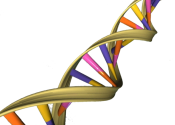
DNA

Deoxyribonucleic acid (DNA) is a nucleic acid that contains the genetic instructions used in the development and functioning of all known living organisms and some viruses. The main role of DNA molecules is the long-term storage of information. DNA is often compared to a set of blueprints or a recipe, or a code, since it contains the instructions needed to construct other components of cells, such as proteins and RNA molecules. The DNA segments that carry this genetic information are called genes, but other DNA sequences have structural purposes, or are involved in regulating the use of this genetic information.

Chemically, DNA consists of two long polymers of simple units called nucleotides, with backbones made of sugars and phosphate groups joined by ester bonds. These two strands run in opposite directions to each other and are therefore anti-parallel. Attached to each sugar is one of four types of molecules called bases. It is the sequence of these four bases along the backbone that encodes information. This information is read using the genetic code, which specifies the sequence of the amino acids within proteins. The code is read by copying stretches of DNA into the related nucleic acid RNA, in a process called transcription.

Within cells, DNA is organized into X-shaped structures called chromosomes. These chromosomes are duplicated before cells divide, in a process called DNA replication. Eukaryotic organisms (animals, plants, fungi, and protists) store most of their DNA inside the cell nucleus and some of their DNA in the mitochondria (animals and plants) and chloroplasts (plants only). Prokaryotes (bacteria and archaea) however, store their DNA in the cell's cytoplasm. Within the chromosomes, chromatin proteins such as histones compact and organize DNA. These compact structures guide the interactions between DNA and other proteins, helping control which parts of the DNA are transcribed.

For more information about DNA, read the full article at Wikipedia.
This text uses material from Wikipedia and is available under the GNU Free Documentation License.