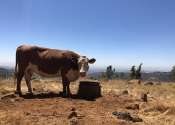
Cattle disease bacteria widespread in the UK
A new study has found that bacteria responsible for chronic intestinal inflammation in cattle, which have also been implicated in Crohn's disease in humans, are widespread in the UK countryside.
(Phys.org)—A recent graduate from the University of Westminster in London, architect Jack Munro has developed a process that uses cattle blood as a binding ingredient in making bricks for use in building ...
A new analysis published today in Science traces the recent global eradication of the deadliest of cattle diseases, crediting not only the development of a new, heat-resistant vaccine, but also the insight of local Africa ...
Texas Longhorn cattle have a hybrid global ancestry, according to a study by University of Texas at Austin researchers published this week in the Proceedings of the National Academy of Sciences.
Kansas State University civil engineers are developing the right mix to reduce concrete's carbon footprint and make it stronger. Their innovative ingredient: biofuel byproducts.
(Phys.org)—Researchers working to increase the number of bridled nailtail wallabies in Queensland Australia, have discovered that stopping the practice of culling dingoes in the area did not change the ...
The drought in America's breadbasket is intensifying at an unprecedented rate, experts warned, driving concern food prices could soar if crops in the world's key producer are decimated.
(Phys.org)—Anthrax has the unexpected ability to grow and reproduce while lurking in soil – increasing the deadly bacteria's chances to infect cattle and other mammals, researchers at the University of Virginia School ...
(Phys.org) -- A new type of cattle gate aimed at preventing farmer death and injury has completed rigorous testing and development by the CSIRO. SaferGate, designed by farmer and inventor Edward Evans, has ...
The first unequivocal evidence that humans in prehistoric Saharan Africa used cattle for their milk nearly 7,000 years ago is described in research by an international team of scientists, led by the University ...
UK researchers have shown for the first time that instead of fleeing randomly when faced with danger, sheep head straight for the center of the flock.
A team of Ugandan and French paleontologists announced Tuesday they had found a 20-million-year-old ape skull in northeastern Uganda, saying it could shed light on the region's evolutionary history.