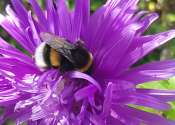
Lonely bees make better guests
Solitary bees are twice as likely to pollinate the flowers they visit as their more sociable counterparts, according to a new study.
When it comes to honey bees, more mates is better. A new study from North Carolina State University, the University of Maryland and the U.S. Department of Agriculture (USDA) shows that genetic diversity is ...
(Phys.org) —Washington State University researchers are preparing to use liquid nitrogen to create a frozen semen bank from select U.S. and European honey bee colonies.
(Phys.org) —In a paper published today in the peer-reviewed science journal PLoS ONE, researchers have presented a new model to explore how changes in food availability might influence honeybee colony growth ...
Fire blight is a serious threat to fruit trees. Now a quick test has been developed at the Vienna University of Technology, which can indicate the danger early - with the help of bees.
The rosemary season has ended, but sage is in full bloom. In the fragrant hills of the Peloponnese in southern Greece, after a few sharp turns along a path, Nikos Reppas' old car arrives at bee heaven: a ...
Wild pollinators – primarily wild bees, flies, and other insects – are at least as important, and often more efficient, at pollinating agricultural crops than domestic honey bee colonies, according to ...
(Phys.org) —A new long-term study of honey bee health has found that a little-understood disease study authors are calling "idiopathic brood disease syndrome" (IBDS), which kills off bee larvae, is the ...
(Phys.org)—While honey bee populations dwindle across the globe, Penn State researchers aim to use communication technologies to spread revolutionary beekeeping techniques that will help offset the effects ...