'Swallowed,' torn up or live on: How Earth will fare when the sun dies
Our solar system and everything within it—including the Earth—will look very different when the sun dies.
The Royal Astronomical Society, (RAS) was established in 1820. The RAS is headquartered in London. The primary mission of RAS is to encourage and promote the study of astronomy, solar-system science, geophysics, and closely related branches of science. RAS accomplishes this mission by publishing scientific studies in journals, the award of modest grants, educational activities and makes available a superior reference library. Membership to RAS is available to anyone with an interest in the fields of endeavors promoted by RAS. Primarily members are students, geophysicists, astronomers and related professionals.
Some content from Wikipedia, licensed under CC BY-SA
Subscribe to rss feed

Our solar system and everything within it—including the Earth—will look very different when the sun dies.
Planetary Sciences
Apr 9, 2024
1
306
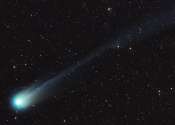
A Mount Everest-sized 'devil' comet making its first visit to the inner solar system in more than 70 years could be visible to the naked eye over the next few weeks.
Astronomy
Mar 25, 2024
0
52

'Hidden' stars including a new type of elderly giant nicknamed 'old smoker' have been spotted for the first time by astronomers. The mystery objects exist at the heart of our Milky Way galaxy and can sit quietly for decades—fading ...
Astronomy
Jan 25, 2024
3
84

Stargazers will have a chance to enjoy one of the most spectacular meteor showers of the year later this week, as the Geminids reach their peak.
Space Exploration
Dec 12, 2023
0
6

Researchers at the Center of Excellence in Space Sciences India at IISER Kolkata have discovered a new relationship between the sun's magnetic field and its sunspot cycle, that can help predict when the peak in solar activity ...
Astronomy
Nov 28, 2023
0
282

An international team of astronomers has carried out what is believed to be the largest ever cosmological computer simulation, tracking not only dark but also ordinary matter (such as planets, stars and galaxies), giving ...
Astronomy
Oct 23, 2023
5
372

A team of scientists from Argentina and Spain have reported the first observational evidence that a type of young low-mass star, known as "T Tauri stars," are capable of emitting gamma radiation. The study is published in ...
Astronomy
Aug 23, 2023
0
410

This year the Perseid meteor shower reaches its peak on the night of 12–13 August, giving skywatchers a potentially impressive summer treat. The meteors are best viewed from the northern hemisphere, and in ideal conditions ...
Astronomy
Aug 2, 2023
0
99

An Australian astronomer has solved a century-old mystery regarding how galaxies evolve from one type to another. The same study shows that the Milky Way, the galaxy we live in, was not always a spiral.
Astronomy
Jul 25, 2023
0
110

New research, in the wake of the gravitational wave discoveries, sheds light on the environments that could lead to black hole merger events. The work is presented this week at the 2023 National Astronomy Meeting by Ph.D. ...
Astronomy
Jul 6, 2023
0
158
