Micro-engines
Micro-engines
A programme for research on millimetre scale internal combustion engines is being jointly developed by Cambridge Combustion Research Centre and the Centre for Micro-Engineering and Nanotechnology at the University of Birmingham. This micro-engine project brings together novelties in fabrication, combustion, and micro-engine design with a close interaction of micro-fabrication and combustion expertise.
Most liquid hydrocarbon fuels hold over 300 times more energy per unit weight than a NiCad battery and 100 times more than a Li-ion battery. A micro-engine would have the potential to release the energy from the fuels and possibly replace batteries in portable devices.
It would not only last much longer than a battery of the same weight (about 20 times at 10% efficiency), but also requires little time to change its fuel capsule. As a highly compact energy source, micro-engines could find applications in medical devices, military equipment, PDAs, notebook computers, mobile phones, and even toys!
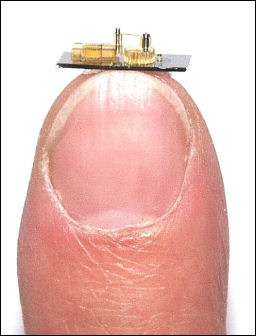
The original idea for making a micro-engine using Micro-Electro-Mechanical Systems (MEMS) technology was proposed by Alan Epstein and Stephen Senturia of Massachusetts Institute of Technology (MIT) in the mid-1990s. Research in Europe started at the University of Birmingham in 1999 and resulted in a patented fabrication process and several prototype micro-engines. The proposed collaboration project between the two Universities intends to produce a micro combustion engine, with platform of 5 x 15 x 3 mm in overall dimension and the expected indicated power output at 11.2 W at a speed of the order of 50,000 rpm.
One of the major problems with the micro-engines is that silicon-based components cannot withstand the high temperatures of combustion. A second barrier is to actually produce sustained combustion in the small dimensions, which are affected by heat transfer. The solution proposed by the investigators is to make micro components out of ceramic materials, and to operate the engine at high speeds using autoignition processes to overcome the heat transfer problem. The investigators are hopeful that the development of the process will allow micro-engines to be brought to the market.
Source: University of Cambridge
-
New nanostructure for batteries keeps going and going,
28 comments
-
Penn astrophysicists zero in on gravity theory,
202 comments
-
Engineer thinks we could build a real starship enterprise in 20 years,
49 comments
-
Sugar makes you stupid: Study shows high-fructose diet sabotages learning, memory,
13 comments
-
Brain oscillations reveal that our senses do not experience the world continuously,
10 comments
More news stories
NY tech fest heralds Silicon Valley of the East
The Big Apple may not have California's weather, but tech fans at New York Internet Week say that in every other way the city is on course to become Silicon Valley 2.0.
23 minutes ago |
not rated yet |
0
"Social Network" writer to pen Steve Jobs film script
Sony Pictures Entertainment on Wednesday said that the Academy Award winning screenwriter behind "The Social Network" will write the script for a film about Apple co-founder Steve Jobs.
51 minutes ago |
1 / 5 (1) |
0
Technology accessibility is improving, but big challenges lie ahead
When the iPad debuted two years ago, there was lots of talk about whether people beyond the iPhone and Mac faithful would use such a thing.
31 minutes ago |
not rated yet |
0
Brainput system takes some brain strain off multi-taskers
(Phys.org) -- A research team made up of members from Indiana University, Tufts and MIT and led by Erin Treacy Solovey, a has built a brain monitoring system that offloads some of the computer related activities ...
Technique enables mass production of custom concrete building components from digital designs
Like other professionals, architects have used computer-aided design (CAD) software in their work for decades. Typically, the resulting digital files are converted to hard-copy plans, which are then used to ...
4 hours ago |
5 / 5 (3) |
2
|
IPhone to get larger screen: A report to take with a grain of salt?
Apple has begun preparing to launch an iPhone with a larger screen than its previous models, according to a report in the Wall Street Journal.
Healthy eating can cost less, study finds
Is it really more expensive to eat healthy? An Agriculture Department study released Wednesday found that most fruits, vegetables and other healthy foods cost less than foods high in fat, sugar and salt.
How do consumers achieve self-affirmation when purchasing products?
People who feel good about themselves are less likely to choose an attractive product than a functional one, according to a new study in the Journal of Consumer Research. But choosing highly aesthetic products may make p ...
Trusting Tiger Woods: How do facial cues affect preference and trust?
People respond to facial cues and this affects their level of trust, according to a new study in the Journal of Consumer Research that looks at the way consumers react to morphed photo images.
Why do consumers dislike corporate brands that get too familiar?
Although it is tempting to use the word "we" to make consumers feel like part of the family, people react negatively when brands overstep their boundaries, according to a new study in the Journal of Consumer Research.
Want to avoid ED following prostate cancer surgery? Find an experienced, gentle surgeon
Prostate cancer is the most commonly diagnosed non-skin cancer in the U.S., and radical prostatectomy, the surgical removal of the prostate gland, remains the most popular therapeutic option, accounting for ...