AIDS Drug from Sunflowers
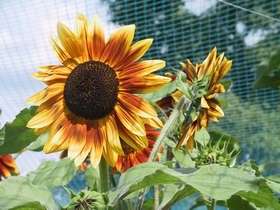
Sunflowers can produce a substance which prevents the AIDS pathogen HIV from reproducing, at least in cell cultures. This is the result of research carried out by scientists at the University of Bonn in cooperation with the caesar research centre. For several years now the hopes for a completely new group of AIDS drugs have been pinned to what is known as 'DCQA'.
However, the substance is only available in very small quantities and is thus extremely expensive. By using the Bonn method it could probably be produced for a fraction of the costs. The researchers have patented their method. Together with the Jülich Research Centre they now want to attempt to manufacture the substance on a large scale. They are looking for partners in industry to help them with this.
It all began with a small mould with the tongue-twisting name sclerotinia sclerotiorum.
The pathogen responsible for the dreaded 'white stem rot' can, if the weather conditions are unfavourable, destroy an entire sunflower crop. However, some sunflowers survive the fungus attack more or less unscathed. They do this by producing specific antibodies which eventually put a stop to the fungus.
The agricultural engineer Claudio Cerboncini wanted to find out what chemical weapons the fungus-resistant sunflowers have at their disposal. In his PhD thesis for Professor Heide Schnabl of the Bonn Centre of Molecular Biotechnology (CEMBIO)
Claudio infected different types with their sworn enemy. In this way he was able to isolate the antitoxins which the plants produce in response to the fungus. Among these was a substance which is also mentioned in the literature, albeit in a completely different context: this is dicaffeoyl quinic acid, or DCQA for short - the highly prized prototype for a new group of AIDS drugs.
One million euros per gram
'Dicaffeoyl quinic acid can prevent the HIV virus from reproducing, at least in cell cultures,' explains Claudio Cerboncini, who is now working at the caesar research centre. 'It is one of the few substances known today which inhibit viral integrase - this is an enzyme which is essential if the pathogen is to reproduce.' In contrast to other enzymes medical experts expect there to be only a few side-effects from such integrase inhibitors. In the pharmaceuticals industry they are therefore seen as the great white hope for a completely new class of AIDS drugs. Initial clinical tests seem to confirm DCQA's potential.
'We need these substances to expand our arsenal of effective weapons against the disease,' Dr. Esther Vogt of the Immunological Out-Patient Service of Bonn University Clinic adds. 'It remains to be seen, however, whether they will prove to be as effective in clinical practice as they seem to be at present.'
DCQA occurs in the artichoke and wild chicory, though in extremely small doses. The market price is therefore currently €1,000 per milligram. 'We want to attempt to cultivate sunflower cells or other plant cells in a nutrient solution together with the mould sclerotinia sclerotiorum and then obtain the enzyme from the liquid,' CEMBIO researcher Ralf Theisen says. 'If things go according to plan, we could produce DCQA at a substantially reduced cost.'
From the ceiling of Ralf Theisen's office hangs the model of a Maxus rocket. As a botanist he is actually doing research on how plants react to gravity, and therefore recently sent some of his test objects into space in a rocket like that. 'We are investigating which genes plants switch on and off under particular gravity conditions,' he explains. 'However, with the methods we use we can also, for example, find out which genes the sunflowers activate when they produce DCQA in reaction to a fungus infection.'
This knowledge would make mass production of DCQA a distinct possibility. Even now chemists can 'copy' the substance, albeit only with great difficulty. 'The tricky bit is transferring the caffeoyl groups to the quinic acid,' Ralf Theisen says. 'The plants probably only have one enzyme, which acts as a catalyst for this transfer. If we can find the construction manual for this enzyme, i.e. the corresponding gene, and can smuggle it into the bacteria, the latter can produce the enzyme in large quantities. The critical step of synthesis would then be child's play and could be carried out on an industrial basis by using the fermentation technology available in Jülich.'
Source: University of Bonn


