Stardust Mission Status Report
Jan 06, 2006
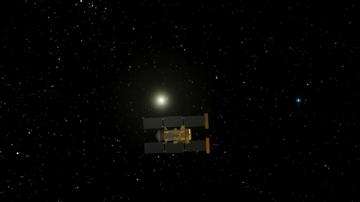
Artist's concept of Stardust
Image: Artist's concept of Stardust near Earth. Image credit: NASA/JPL

Ten days before its historic return to Earth with the first-ever samples from a comet, NASA's Stardust spacecraft successfully performed its 18th flight path adjustment. This second-to-last scheduled maneuver puts the spacecraft on the right path to rendezvous with Earth on Jan. 15 (Universal Time), when it will release its sample return capsule.

At 1800 Universal Time (10:00 am Pacific Time) on Thursday, Jan. 5, Stardust fired all eight of its 4.4 newton (1-pound) thrusters for a total of 107 seconds, changing the comet sampler's speed by 2.4 meters per second (about 5.4 miles per hour). The maneuver required 385 grams (0.85 pounds) of hydrazine monopropellant to complete. A final trajectory correction maneuver is scheduled prior to release of the sample return capsule.

"It was a textbook maneuver," said Ed Hirst, Stardust deputy mission manager at NASA's Jet Propulsion Laboratory, Pasadena, Calif. "After sifting through all the post-burn data, I expect we will find ourselves right on the money."

In the early morning hours of January 15, 2006, the Stardust mission returns to Earth after a 4.63 billion kilometer (2.88 billion mile) round-trip journey carrying a precious cargo of cometary and interstellar dust particles. Scientists believe Stardust's cargo will help provide answers to fundamental questions about the origins of the solar system.

Scientists believe in-depth terrestrial analysis of cometary samples will reveal much not just about comets but about the earliest history of the solar system. Locked within the cometary particles is unique chemical and physical information that could be the record of the formation of the planets and the materials from which they were made.

Extensive information on the Stardust mission is available from the Stardust site at www.nasa.gov/stardust .

Source: NASA

Explore further: Slovenian flyer lands in France on return trip from Arctic

add to favorites email to friend print save as pdf

Related Stories

NASA's Stardust: Good to the last drop

Mar 24, 2011

(PhysOrg.com) -- On Thursday, March 24 at about 4 p.m. PDT (7 p.m. EDT), NASA's Stardust spacecraft will perform a final burn with its main engines.

Stardust celebrates twelve years with rocket burn

Feb 09, 2011

(PhysOrg.com) -- NASA's Stardust spacecraft marked its 12th anniversary in space on Monday, Feb. 7, with a rocket burn to further refine its path toward a Feb. 14 date with a comet.

Stardust spacecraft adjusts flight path for comet meetup

Feb 02, 2011

(PhysOrg.com) -- Just over two weeks before its flyby of comet Tempel 1, NASA's Stardust spacecraft fired its thrusters to help refine its flight path toward the comet. The Stardust-NExT mission will fly past ...

NASA plans Valentine's date with a comet

Jan 19, 2011

Like two strangers in the night, a US spacecraft and a speeding comet will dash by one another on Valentine's Day, NASA said Wednesday, and skywatchers are eager to see what happens.

Recommended for you

Hubble reveals the ring nebula's true shape

3 hours ago

(Phys.org) —The Ring Nebula's distinctive shape makes it a popular illustration for astronomy books. But new observations by NASA's Hubble Space Telescope of the glowing gas shroud around an old, dying, ...

NASA head views progress on asteroid lasso mission

4 hours ago

Surrounded by engineers, NASA chief Charles Bolden inspected a prototype spacecraft engine that could power an audacious mission to lasso an asteroid and tow it closer to Earth for astronauts to explore.

Ecuador satellite collides with Russian space junk

4 hours ago

A small Ecuadoran satellite collided in orbit with the remains of a Russian rocket, but it is too soon to know how much damage it might have sustained, Quito's space agency said Thursday.

User comments : 0

More news stories

Hubble reveals the ring nebula's true shape

(Phys.org) —The Ring Nebula's distinctive shape makes it a popular illustration for astronomy books. But new observations by NASA's Hubble Space Telescope of the glowing gas shroud around an old, dying, ...

NASA head views progress on asteroid lasso mission

Surrounded by engineers, NASA chief Charles Bolden inspected a prototype spacecraft engine that could power an audacious mission to lasso an asteroid and tow it closer to Earth for astronauts to explore.

A hidden population of exotic neutron stars

(Phys.org) —Magnetars – the dense remains of dead stars that erupt sporadically with bursts of high-energy radiation - are some of the most extreme objects known in the Universe. A major campaign using ...

Controlling mood through the motions of mitochondria

(Medical Xpress)—Regulating the distribution of power in neurons is done by a system that makes the national electric grid look simple by comparison. Each neuron has several thousand mitochondria confined ...

Google Drive sports new view and scan enhancements

(Phys.org) —Google Drive has a new look and functions. The makeover in Google Drive features scanning and interface enhancements that put the user into "card" mode. The enhancements make it easy for the ...