Scientific Surprise Greets Researchers at Higher Magnetic Fields
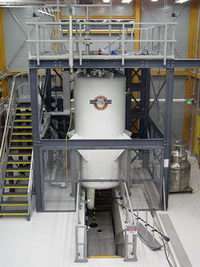
Research performed by a team at Florida State University's National High Magnetic Field Laboratory suggests that the benefits of building higher-field superconducting magnets likely will far outweigh the costs of building them.
FSU researchers Riqiang Fu, Ozge Gunaydin-Sen and Naresh Dalal discovered something they weren't expecting while trying to improve the resolution, or quality of image, in the magnet lab's unique 900-megahertz, 21.1-tesla magnet. While experimenting with the giant magnet, the three noted an exponential increase in the ease of detecting the "fingerprint" of the chemical compound they were studying as they exposed it to ever-higher magnetic fields.
A paper describing their research was published recently in the Journal of the American Chemical Society.
"This paper has very strong implications for the United States staying ahead in magnet technology, which would bring great dividends in research and improvements in medical imaging," said Tim Cross, director of the magnet lab's NMR User Program and a professor of chemistry and biochemistry at FSU. "We need - and are working on - additional fundamental studies that show the benefits of going to higher fields."
Nuclear magnetic resonance, or NMR, generates a true-to-life fingerprint - a unique pattern indicating the presence of specific molecules - for a research sample that is being analyzed. As a technique, NMR is very accurate as long as one can detect the sample in the first place. The ease or difficulty of detecting a sample is known as "sensitivity." Low sensitivity has been one of NMR's biggest liabilities, because the lower the sensitivity, the longer the experiment takes. Such slowness has limited NMR's potential applications.
"Poor signal is like a faint picture in the darkness," said Dalal, the Dirac Professor of Chemistry and Biochemistry at FSU. "We've shown that the '900' (magnet) increases the picture's brightness by a factor of about 10 relative to low-field images. Think of how much more you can see in a room that is that much brighter ... and imagine what you'd see at even higher fields."
Theorists had predicted a linear increase in both resolution and sensitivity at higher magnetic fields, moving from 14.1 tesla to 21.1 tesla, the current state of the art in superconducting magnets. In their experiment, the FSU team members observed an exponential increase - with the sensitivity increasing by a factor of three over what had been predicted.
Higher sensitivity in a magnet means it takes far less time - or much less of a sample - to conduct an experiment.
"The reduction in time is like going from one hour to a couple of minutes," said Fu, an associate scholar/scientist at the magnet lab and the FSU chemistry department. "Many experiments take weeks, and such a reduction in time will allow for far more studies to be conducted on a single instrument."
Dalal said the shortening of experimental time increases scientists' ability to fingerprint materials, opening up new areas of scientific investigation in NMR, including the study of materials useful in nanotechnology and medical imaging. The need for less of a sample - up to 18 times less - will open up high-field NMR to the study of enzymes and purified proteins, an area in which samples typically are of limited size.
The paper can be accessed at pubs.acs.org/cgibin/article.cg … 03/pdf/ja067179j.pdf .
Source: Florida State University


