Spitzer Unveils Infant Stars in the Christmas Tree Cluster
Dec 22, 2005
Spitzer Unveils Infant Stars in the Christmas Tree Cluster
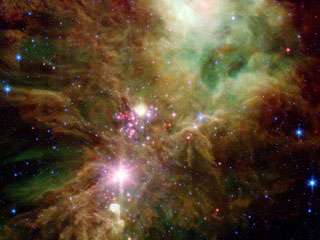
Image: Spitzer spots a stellar snowflake on the "Christmas Tree Cluster." The infant stars appear as pink and red specks in the snowflake-shaped cluster at the center of the image. Astronomers combined light from Spitzer's IRAC and MIPS cameras in this mosaic. (Photo: NASA/JPL/SSC)

Astronomers using NASA's Spitzer Space Telescope have given the world a spectacular new picture of a star-forming region called the "Christmas Tree Cluster," complete with first-ever views of a group of newborn stars still linked to their siblings.

Spitzer's cameras are very sensitive to the infrared (heat), allowing astronomers to see through the obscuring gas and dust of the star-forming cloud that swaddles infant stars.

The Christmas Tree Cluster, also known as NGC 2264, is a well-studied region in the Monoceros (the Unicorn) constellation. The Christmas Tree Cluster was so named because it looks like a tree in visible light. The nebula is roughly 2,500 light-years away. That is, the nebula emitted the light in the new Spitzer image 2,500 years ago.

For astronomers studying the development of very young stars -- stars less than a few million years old -- "This region has it all," said University of Arizona astronomer Erick T. Young.

"We see the dramatic-looking emission of cold gas -- clouds that look like thunderheads. We see when the massive molecular cloud breaks up and begins to condense into clumps of stars," Young said. "And, for the first time, because of Spitzer's sensitivity, we can see individual stars roughly the size of our sun tightly packed within those clumps." The cluster of stars is so tightly packed that they must be less than 100,000 years old, he added.

Astronomers are calling this compact collection of bright protostars within the Christmas Tree Cluster the "Snowflake Cluster" because of how they are spaced. The newborn stars are patterned like a single feathery crystal of snow, or geometrically spaced like spokes in a wheel.

The Spitzer observations show that just as theory predicts, the density and temperature of the initial star-forming cloud dictates the spacing between the protostars.

Young is deputy principal investigator for Spitzer's Multiband Imaging Photometer (MIPS), a UA-built camera that took the longest wavelengths of infrared light used in Christmas Tree Cluster mosaic. Astronomers combined light from MIPS and Spitzer's Infrared Array Camera (IRAC), developed by the Smithsonian Astrophysical Observatory, in constructing in the picture.

Source: University of Arizona

Explore further: Russia retrieves mice, newts from space

add to favorites email to friend print save as pdf

Related Stories

Quasar may be embedded in unusually dusty galaxy

Oct 23, 2012

Hubble astronomers have looked at one of the most distant and brightest quasars in the universe and are surprised by what they did not see: the underlying host galaxy of stars feeding the quasar. The best ...

Hubble zooms in on a magnified galaxy

Feb 02, 2012

(PhysOrg.com) -- Thanks to the presence of a natural "zoom lens" in space, NASA's Hubble Space Telescope got a uniquely close-up look at the brightest "magnified" galaxy yet discovered.

Saturn only visible planet through the month of April

Apr 01, 2011

(PhysOrg.com) -- For those who enjoy viewing clusters of planets, the evening sky in April may be a bit disappointing. Saturn will be the only planet visible for most of the night, until the sky starts to ...

Cosmic magnifying lenses distort view of distant galaxies

Jan 12, 2011

Looking deep into space, and literally peering back in time, is like experiencing the universe in a house of mirrors where everything is distorted through a phenomenon called gravitational lensing. Gravitational ...

Recommended for you

Proba-V opens its eyes

just added

(Phys.org) —Earth watcher Proba-V is in good health following its launch last week. The Vegetation imager has been switched on and the first image has been captured over western France.

Big pig poo problem solved

3 hours ago

An Australian led-project to turn 1.4 million tonnes of Chinese pig poo into alternative energy and fertiliser has been hailed in a national science award.

User comments : 0

More news stories

Cracking the ice code

(Phys.org) —What happened the last time a vegetated Earth shifted from an extremely cold climate to desert-like conditions? And what does it tell us about climate change today?

Breakthrough calls time on bootleg booze

(Phys.org) —Using a laser, the St Andrews scientists can now carry out detailed analysis of a spirit sample no bigger than a teardrop and can even confirm whether it is toxic or not. It's hoped the testing ...