Gift-Bearing Progress Launches Toward Space Station
Dec 21, 2005
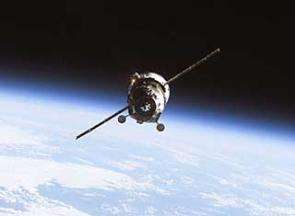
An unpiloted Progress supply vehicle approaches the International Space Station. Credit: NASA

The 20th unpiloted Progress cargo craft launched toward the International Space Station Wednesday at 1:38 p.m. EST, carrying Christmas gifts, equipment and supplies to the orbiting laboratory. It is scheduled to dock at the Pirs Docking Compartment Friday at 2:54 p.m.

Image: An unpiloted Progress supply vehicle approaches the International Space Station. Credit: NASA

The Progress reached orbit about 10 minutes after launch from the Baikonur Cosmodrome in Kazakhstan. Its solar arrays and antennas were deployed normally.

With the Soyuz that brought the Expedition 12 crew to the station and will take them home, P20 will bring to three the number of Russian vehicles at the station.

Its sister and predecessor at the station, Progress 19, will remain docked to the aft port of the Zvezda Service Module. Generally a Progress is undocked and deorbited shortly before the launch of the next Progress, to clear that docking port for the new arrival.

In this case, mission managers have decided that Progress 19 will stay at the station so its remaining oxygen can be transferred. That also will give station crewmembers, Commander Bill McArthur and Cosmonaut Valery Tokarev, a chance to fill it completely with garbage and unneeded equipment. It will re-enter and burn in the Earth's atmosphere shortly after its undocking, scheduled for early March.

The P20 cargo weighs about 5,680 pounds. It comprises 1,940 pounds of propellant, 183 pounds of oxygen and air, 463 pounds of water and almost 3,100 pounds of dry cargo.

In addition to Christmas presents, the dry cargo consists of equipment and supplies, experiment hardware, spare parts for the station, repair gear and life support system hardware.

The Progress is similar in appearance and some design elements to the Soyuz spacecraft, which brings three crewmembers to the station, serves as a lifeboat while they are there and returns them to Earth. The aft module, the instrumentation and propulsion module, is nearly identical.

But the second of the three Progress sections is a refueling module, and the third, uppermost as the Progress sits on the launch pad, is a cargo module. On the Soyuz, the descent module, where the crew is seated on launch and which returns them to Earth, is the middle module and the third is called the orbital module.

Source: NASA

Explore further: Galaxy's Ring of Fire

add to favorites email to friend print save as pdf

Related Stories

ESA workhorse to power NASA's Orion spacecraft

Jan 17, 2013

(Phys.org)—The ATV-derived service module, sitting directly below Orion's crew capsule, will provide propulsion, power, thermal control, as well as supplying water and gas to the astronauts in the habitable ...

Recommended for you

Galaxy's Ring of Fire

7 hours ago

Johnny Cash may have preferred this galaxy's burning ring of fire to the one he sang about falling into in his popular song. The "starburst ring" seen at center in red and yellow hues is not the product of ...

Mars rover Opportunity examines clay clues in rock

13 hours ago

(Phys.org) —NASA's senior Mars rover, Opportunity, is driving to a new study area after a dramatic finish to 20 months on "Cape York" with examination of a rock intensely altered by water.

Chinese, Indian airlines face EU pollution fines

18 hours ago

Eight Chinese and two Indian airlines face fines of up to several million euros for not paying for their greenhouse gas emissions during flights within the bloc, the European Commission said on Friday.

Alaska volcano shoots ash 15,000 feet into the air

18 hours ago

(AP)—One of Alaska's most restless volcanoes has shot an ash cloud 15,000 feet into the air in an ongoing eruption that has drawn attention from a nearby community but isn't expected to threaten air traffic.

NASA's STEREO detects a CME from the sun

May 17, 2013

On 5:24 a.m. EDT on May 17, 2013, the sun erupted with an Earth-directed coronal mass ejection or CME, a solar phenomenon that can send billions of tons of solar particles into space that can reach Earth ...

User comments : 0

More news stories

Galaxy's Ring of Fire

Johnny Cash may have preferred this galaxy's burning ring of fire to the one he sang about falling into in his popular song. The "starburst ring" seen at center in red and yellow hues is not the product of ...

Alaska volcano shoots ash 15,000 feet into the air

(AP)—One of Alaska's most restless volcanoes has shot an ash cloud 15,000 feet into the air in an ongoing eruption that has drawn attention from a nearby community but isn't expected to threaten air traffic.

Chinese, Indian airlines face EU pollution fines

Eight Chinese and two Indian airlines face fines of up to several million euros for not paying for their greenhouse gas emissions during flights within the bloc, the European Commission said on Friday.

Morocco to harness the wind in energy hunt

Morocco is ploughing ahead with a programme to boost wind energy production, particularly in the southern Tarfaya region, where Africa's largest wind farm is set to open in 2014.

US seizes Bitcoin operator accounts

US authorities seized the accounts of a Bitcoin digital currency exchange operator, claiming it was functioning as an "unlicensed money service business," court documents showed Friday.