Lizards 'Shout' Against a Noisy Background
Feb 21, 2007
Lizards 'Shout' Against a Noisy Background
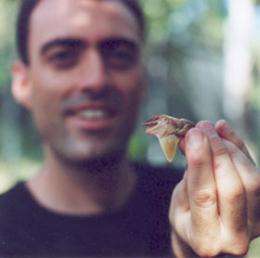
Postdoctoral researcher Terry Ord says anole lizards, such as this one, create a strategy to get their message across to rivals. Credit: UC Davis

Lizards that signal to rivals with a visual display "shout" to get their point across, UC Davis researchers have found.

Male anole lizards signal ownership of their territory by sitting up on a tree trunk, bobbing their heads up and down and extending a colorful throat pouch. They can spot a rival lizard up to 25 meters away, said Terry Ord, a postdoctoral researcher at UC Davis who is working with Judy Stamps, professor of evolution and ecology.

The lizards' signals need to be strong enough for a rival to see, but not vivid enough to say "eat me" to a passing predator. But their forest home can be a visually noisy environment, with branches and leaves waving in the breeze and casting patterns of light and shade.

"They have to have a strategy to get their message across," Ord said.

Ord videotaped two species of anole lizards, Anolis cristatellus and Anolis gundlachi, in the Caribbean National Forest in Puerto Rico. He found that the more "visual noise" in the background, the faster and more exaggerated the movements of the lizards.

Anole lizards are interesting to evolutionary biologists because different species are found on different islands all over the Caribbean. The lizards are not particularly closely related -- they are separated by 30 million years of evolution -- but they live in similar environments with the same obstacles to communication. So Ord is using them as a model to investigate the evolution of such signals.

The other authors on the paper, which is published online in Proceedings of the Royal Society part B, are Richard A. Peters, Australian National University, Canberra; and Barbara Clucas, a graduate student in animal behavior at UC Davis.

Source: UC Davis

Explore further: Navy dolphins discover rare old torpedo off Calif. coast near Coronado

add to favorites email to friend print save as pdf

Related Stories

Robosquirrels versus rattlesnakes

Apr 03, 2012

Robot squirrels from the University of California, Davis, are going into rattlesnake country near San Jose, continuing a research project on the interaction between squirrels and rattlesnakes.

The eyes have it: Dinosaurs hunted by night

Apr 14, 2011

The movie Jurassic Park got one thing right: Those velociraptors hunted by night while the big plant-eaters browsed around the clock, according to a new study of the eyes of fossil animals. The study will ...

Family ties bind desert lizards in social groups

Oct 06, 2010

(PhysOrg.com) -- Researchers at the University of California, Santa Cruz, have found that a species of lizard in the Mojave Desert lives in family groups and shows patterns of social behavior more commonly ...

Warm-blooded sea reptiles of the Jurassic

Jun 10, 2010

(PhysOrg.com) -- New evidence shows that reptiles roaming the oceans at the time of the dinosaurs could maintain a constant body temperature well above that of the surrounding water.

For horned lizard, horns alone do not make the species

Jul 21, 2009

How do you recognize a new species? A thorough study of the million-year evolution of California's horned lizards, sometimes referred to as "horny toads," shows that when it comes to distinguishing such recently ...

Robo-lizards help prove long-standing signaling theory

Nov 24, 2008

(PhysOrg.com) -- Like teachers who rap a ruler before announcing homework in noisy classrooms, Puerto Rican anole lizards perform eye-catching pushups before beginning head-bobbing displays that advertise ...

Recommended for you

EU bans three pesticides harmful to bees

May 24, 2013

The European Commission said Friday that it will ban for two years beginning in December pesticides blamed for killing the bees that pollinate food and fruit crops.

Studying the Noble King Mackerel

May 24, 2013

They are sometimes called "smokers," due to the speed at which a fishing line zips out the reel and "smokes" after they hit on the bait.

User comments : 0

More news stories