Progress to Sub for Santa at Space Station
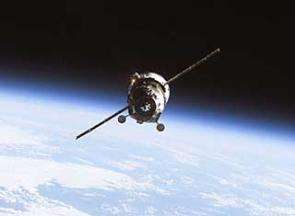
A new Progress will bring Christmas gifts to the International Space Station, but there will be no Santa coming down a chimney. The unpiloted cargo carrier will use the Pirs Docking Compartment.
Image: An unpiloted Progress supply vehicle approaches the International Space Station. Credit: NASA
It will be the 20th Progress to visit the International Space Station, and will double the number of unpiloted cargo carriers at the orbiting outpost. With the Soyuz TMA that brought the Expedition 12 crew to the station and will take them home, P20 brings to three the number of Russian vehicles at the station.
Its sister and predecessor at the station, Progress 19, will remain docked to the aft port of the Zvezda Service Module. Generally a Progress is undocked and deorbited shortly before the launch of the next Progress, to clear that docking port for the new arrival.
In this case, mission managers have decided that Progress 19 will remain at the station so its remaining oxygen and propellant can be transferred. That also will give station crewmembers, Commander Bill McArthur and Cosmonaut Valery Tokarev, a chance to fill it completely with garbage and unneeded equipment. It will re-enter and burn in the Earth's atmosphere shortly after its undocking, scheduled for early March.
P20 is to launch from the Baikonur Cosmodrome in Kazakhstan Dec. 21 at 1:38 p.m. EST. Docking to Pirs is scheduled for Dec. 23 at 2:55 p.m.
The P20 cargo weighs about 5,680 pounds. It comprises 1,940 pounds of propellant, 183 pounds of oxygen and air, 463 pounds of water and almost 3,100 pounds of dry cargo.
The dry cargo consists of equipment and supplies, experiment hardware, spare parts for the station, repair gear and life support system hardware.
The Progress is similar in appearance and some design elements to the Soyuz spacecraft, which brings three crewmembers to the station, serves as a lifeboat while they are there and returns them to Earth. The aft module, the instrumentation and propulsion module, is nearly identical.
But the second of the three Progress sections is a refueling module, and the third, uppermost as the Progress sits on the launch pad, is a cargo module. On the Soyuz, the descent module, where the crew is seated on launch and which returns them to Earth, is the middle module and the third is called the orbital module.
Source: NASA


