Unexpected finding: Some dinosaurs grew slower in hard times
Palaeontologists from the University of Bonn report on an intriguing diagnosis in the 16 December issue of the journal Science. A dinosaur which they have examined was apparently able to vary the speed of its growth according the conditions obtaining in its environment. Although tortoises and crocodiles also do this, plateosaurus engelhardti seems to be unique among dinosaurs, leading experts to puzzle over whether the family history of the dinosaurs will need to be rewritten.
'Basically dinosaurs grew like we do,' the Bonn palaeontologist Dr. Martin Sander explains: 'Each age corresponded to a particular body size.' There was not much leeway involved. Reptiles do things differently: when food is scarce they grow more slowly than when there is food galore. Thus, a tortoise can be 30, 40 or even 60 centimetres long at the same age. 'Warm-blooded animals, by contrast, cannot so easily turn down their metabolism,' the lecturer says: 'If the food supply is inadequate, there's only one thing they can do - die.'
Dinosaurs lie somewhere in between: although they are descended from the reptiles, many of them had become warm-blooded, most researchers today agree. And they all grew like modern mammals: in accordance with a genetically programmed blueprint and in addition relatively fast. 'At least that's what was thought until recently,' Dr. Sander says. 'However, our findings have thrown this conception into disarray, at least for one dinosaur.'
The Swabian lindworm
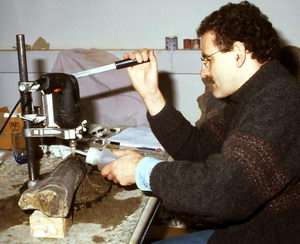
The dinosaur involved is plateosaurus engelhardti, the most important 'German' dinosaur, to judge from the number of fossil finds. The 'Swabian lindworm' (the finds are mainly located in Swabia, in South-West Germany) lived about 200 million years ago and was the first really big dinosaur. It grew up to 10 metres long and weighed several tons. It belonged to the group of the prosauropods, from which the giant dinosaurs later evolved. Martin Sander and his assistant Nicole Klein have subjected the plateosaur's bones to careful scrutiny. The growth of dinosaurs' bones was characterised by temporary interruptions, so that 'annual growth rings' can be detected under the microscope, rather like the growth rings of trees.
Annual rings in the bones
When growth is fast, the distance between the rings is greater. The bone tissue is then permeated with numerous longish cavities. 'However, in many animals, at least at times, the annual rings were markedly closer together,' Dr. Sander continues. 'In these phases the dinosaurs seem to have only grown slowly.' From the bone structure experts can also detect when the animals reached their full size: 'Some had reached their maximum size at 12 years old, others were still growing at 27 � we did not investigate finds of older animals.' The smallest plateosaur was only 4.8 metres when fully grown - a veritable dwarf. Others were more than twice as long.
What is above all astonishing is that all the other dinosaurs seemed to show very steady growth. This is not only true of the plateosaur's closest relations, but also of dinosaurs which came onto the evolutionary stage well before plateosaurs and which therefore could perhaps be assumed to have shown a more 'reptilian' type of growth. 'These findings are puzzling,' Martin Sander admits. 'Of course the plateosaur may simply be an exception. However, we do not see this hypothesis as being very likely. Perhaps the extant finds have not been correctly interpreted. Or the dinosaurs' family tree as we imagine it is simply not accurate.'
Source: University of Bonn


