Space saving approach to satellite communications
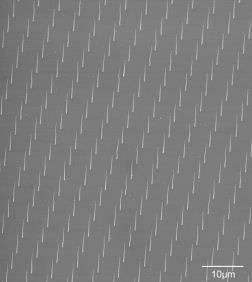
Ken Teo and his team at the University of Cambridge have come up with a much more efficient and compact way to send signals from satellites. They have managed to use an array of carbon nanotubes to create a device that replaces conventional heavy, bulky, high temprature, microwave amplifiers. The new electron source promises to revolutionise telecommunications and satellite communications in space.
Image: CNT emitter ray
Long range communications are a vital part of our lives for business, entertainment or just keeping in contact with friends and family. Much of this, especially to remote areas, is made possible through communications using satellite-based transmitters. There are typically 50 microwave amplifiers on board a satellite, each weighing about 1kg and measuring about 30cm in length.
Currently it costs about 10,000 pounds sterling to send a single kilogram of payload (data) into space. There is an advantage, both in terms of cost savings and extra payload which can be carried, if the weight and size of the microwave devices are reduced.
The microwave amplification devices used in space today are based on what's known as hot cathode technology. Ken and his team have demonstrated that a cold cathode source, based on carbon nanotube technology, can deliver electrons directly at microwave, that is gigahertz, frequencies and hence can be utilized in these microwave devices without delay, with potential weight and size savings of up to 50%. This will not only reduce the cost and increase the capability of conventional satellite systems, but will also enable the drive towards very low cost micro-satellites which weigh about 10kg.
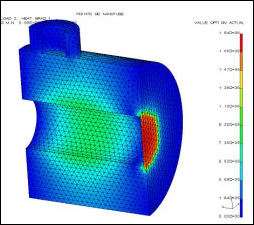
Right: High frequency CNT cathode
Carbon nanotubes are graphite sheets of carbon which are rolled up to form tubes. These tubes have diameters which are in the nanometer range and lengths from the micron to millimeter range. Carbon nanotubes are extremely conductive and have great mechanical strength. Ken and his team use carbon nanotubes as very sharp, highly conductive needles. The nanotubes are laid out into an array, with every nanotube having roughly the same height and diameter. They look like a bed of needles, but at the nanoscale. When these carbon nanotube needles are subjected to an electric field, such as that from an electromagnetic wave, they release electrons from their tips. By injecting radio frequency waves at the nanotubes, they are able to cycle them on and off at the frequency of the injected wave and thus create an electron beam at high frequency. They have done this at 1.5GHz and recently at 32GHz as well. Frequencies of 30Ghz and above, where there are plentiful channels, are where the communication links of the future will reside.
The new cold cathode source is very different from conventional hot cathode amplifiers. These have 4 parts: the direct current hot cathode electron source at 1000 degrees centigrade which generates a constant stream of electrons; an input stage to impose the signal onto the electrons; an output stage to retrieve the amplified signal from the electrons; and finally a collector stage to catch any wasted electrons. They are bulky, heavy, inefficient and slow to heat up.
In summary the advantages of this new carbon nanotube source are as follows. No heating is required and the source can be turned on and off instantaneously. The source and input stages of the microwave amplifier are also combined, producing a size and weight reduction. Finally, the whole concept of operation is different. With the conventional hot cathode source, we have a stream of electrons in which the electrons are modulated by speed to create bunches, and it is these bunches which are extracted as useful output. With the new cold cathode carbon nanotube source, the electrons bunches are instantaneously created at the source.
For more information please go to www-g.eng.cam.ac.uk/cnt
Source: University of Cambridge


