SpaceX Delays Maiden Flight of Falcon 1 Rocket
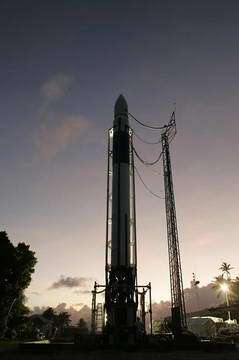
Space Exploration Corp. (SpaceX) launch scrubbed Saturday because of problems with liquid oxygen (LOX) fill tank. The reason for the delay was that an auxiliary liquid oxygen fill tank had a manual vent valve incorrectly set to vent. The time it took to correct the problem resulted in significant LOX boiloff and loss of helium, and it was the latter that caused the launch abort.
Although SpaceX engineers were eventually able to refill the vehicle LOX tanks, the rate at which they could add helium was slower than the rate at which LOX was boiling away. There was no way to close the gap, so the launch had to be called off. In addition, SpaceX experienced an anomaly with the main engine computer that requires further investigation and was arguably reason in and of itself to postpone launch.
It will be a minimum of one or two weeks before the company can try again.
SpaceX developed its partially reusable Falcon 1 rocket as a low-cost alternative in a space launch industry dominated by aerospace giants Boeing Co. and Lockheed Martin Corp.
Designed from the ground up by SpaceX, Falcon 1 is a two stage rocket powered by liquid oxygen and purified, rocket grade kerosene. The Falcon 1 launch will make history for several reasons:
-- It will be the first privately developed, liquid fueled rocket to reach orbit and the world's first all new orbital rocket in over a decade.
-- The main engine of Falcon 1 (Merlin) will be the first all new American hydrocarbon booster engine to be flown in forty years and only the second new American booster engine of any kind in twenty-five years.
-- The Falcon 1 is the only rocket flying 21 st century avionics, which require a small fraction of the power and mass of other systems.
-- It will be the world's only semi-reusable orbital rocket apart from the Shuttle (all other launch vehicles are completely expendable).
-- Most importantly, Falcon 1, priced at $6.7 million, will provide the lowest cost per flight to orbit of any launch vehicle in the world, despite receiving a design reliability rating equivalent to that of the best launch vehicles currently flying in the United States.
The maiden flight will take place from the Kwajalein Atoll of the Marshall Islands. The customer for this mission is DARPA and the Air Force and the payload will be FalconSat-2, part of the Air Force Academy’s satellite program that will measure space plasma phenomena, which can adversely affect space-based communications, including GPS and other civil and military communications. The target orbit is 400 km X 500 km (just above the International Space Station) at an inclination of 39 degrees.
Source: Space Exploration Corp.


