Japanese probe lands on asteroid again and apparently takes samples
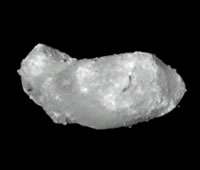
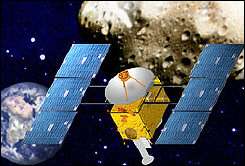
A Japanese Hayabusa spacecraft successfully landed on a far-away asteroid Saturday for a second time and almost certainly collected the first-ever samples from such a celestial body, Japan's space agency said.
The Hayabusa probe, which successfully touched down on the rotating Itokawa asteroid last Sunday but failed to collect material, was set to try again.
The Hayabusa probe is on a landmark mission to bring back material samples from the Itokawa asteroid 290 million kilometers (180 million miles) from Earth to help scientists learn more about how the solar system was created.
It could also provide vital information about the composition and structure of asteroids for any future efforts to deflect a celestial object on a collision course with Earth.
The unmanned craft fired a small metal ball at the asteroid's surface to stir up material for collection and the operation went "without failure," a spokesman for the Japan Aerospace Exploration Agency (JAXA) said.
"As this asteroid was estimated to have emerged roughly 4.6 billion years ago, when the solar system was created, the samples could be something like fossils of the solar system," he added.
Although researchers will not know for sure whether it picked up surface material until the craft returns to Earth in 2007 -- after travelling a total of two billion kilometres -- they said they were confident it worked.
"I'm sure we could collect samples," said project manager Junichiro Kawaguchi, although he added that he needed more circumstantial evidence to say with certainty that the attempt was successful.
"We have overcome the biggest challenge in the project," he added. The mission was all the more difficult because the potato-shaped Itokawa asteroid -- 540 meters (590 yards) long and 270 meters wide on the larger end -- is revolving and has very low gravity, making it tough for Hayabusa to land on a targeted site such as a flat area on the jagged surface.
However, the six-meter probe successfully touched down at 7:07 am Japanese local time (2207 GMT Friday) and its computer system shot the metal ball to collect samples as programmed before taking off again, said JAXA official Yasunori Matoba.
"The project team members were very delighted to have seen all the procedures of collecting samples apparently ended without any problem," Kawaguchi said.
The probe had already touched down on the asteroid on the previous Sunday -- the first time that a space probe has landed and departed from such a celestial body -- but failed to collect material on that occasion as it temporarily lost contact with Earth for technical reasons.
Hayabusa was launched in May 2003 with a budget of 12.7 billion yen (just over 100 million dollars) and is scheduled to return to Earth in June 2007.
At a distance from Earth equal to half the distance to the Moon, the capsule containing samples collected from the asteroid is due to detach from the probe.
After entering the atmosphere at a speed of 12 kilometres per second, heating up to 3,000 degrees C (5,432 degrees F), the capsule is scheduled to land in the Australian desert.
Japan's space program has been eyeing more ambitious projects after its humiliating setback in November 2003 when it had to destroy a rocket carrying a satellite to spy on communist neighbor North Korea shortly after lift-off when one of two rocket boosters failed to separate.
In February, Japan sent a weather satellite into space, its first launch since the 2003 failure.
Japan's Minister of Education, Culture, Sports, Science and Technology Kenji Kosaka said the collection of samples "is a world first" and expressed his pleasure at the news of the apparent success.
Copyright 2005 AFP


