Einstein's relativity theory proven with the 'lead' of a pencil
Nov 09, 2005
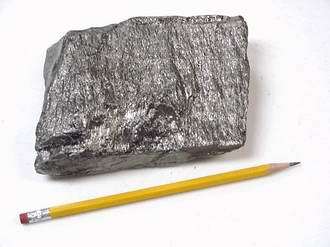
Pencil and Graphite

Scientists at The University of Manchester have discovered a new way to test Einstein's theory of relativity using the 'lead' of a pencil.

Until now it was only possible to test the theory by building expensive machinery or by studying stars in distant galaxies, but a team of British, Russian and Dutch scientists has now proven it can be done in the lab using an ultra-thin material called Graphene.

The group, led by Professor Andre Geim of the School of Physics and Astronomy, discovered the one atom thick material last year. Graphene is created by extracting one atom thick slivers of graphite via a process similar to that of tracing with a pencil.

Professor Geim, said: "To understand implications of the relativity theory, researchers often have to go considerable lengths, but our work shows that it is possible to set up direct experiments to test relativistic ideas. In theory, this will speed up possible discoveries and probably save billions of pounds now that tests can be set up using Graphene and relatively inexpensive laboratory equipment."

In a paper published in Nature (November 10, 2005), the team describes how electric charges in Graphene appear to behave like relativistic particles with no mass (zero rest mass). The new particles are called massless Dirac fermions and are described by Einstein's relativity theory (so-called the Dirac equation).

The team also reports several new relativistic effects. They have shown that massless Dirac fermions are pulled by magnetic fields in such a manner that they gain a dynamic (motion) mass described by the famous Einstein's equation E=mc2. This is similar to the case of photons (particles of light) that also have no mass but can still feel the gravitational pull of the Sun due their dynamic mass described by the same equation.

Dr Kostya Novoselov, a key investigator in this research, added: "The integer and fractional quantum Hall effects are two of the most remarkable discoveries of the late 20th century. It is not easy to explain their significance but both discoveries led to Nobel prizes. One can probably appreciate the importance of our present work in terms of fundamental physics, if I mention that one of the phenomena we report is a new, relativistic type of the quantum Hall effect."

Source: University of Manchester

Explore further: As chaos celebrates its 50th birthday, biophysicist develops a new method to visualize it

add to favorites email to friend print save as pdf

Related Stories

Researcher explores the potential of graphene

Oct 11, 2012

Research by Victoria University Professor Uli Zuelicke is contributing to the global race to unlock the potential of graphene, a new material taken from graphite that scientists say could be a game changer for new electronic ...

UWM discovery advances graphene-based electronics

Apr 16, 2012

(Phys.org) -- Scientists and engineers at the University of Wisconsin-Milwaukee (UWM) have discovered an entirely new carbon-based material that is synthesized from the “wonder kid” of the carbon ...

Recommended for you

A quantum simulator for magnetic materials

3 hours ago

Physicists understand perfectly well why a fridge magnet sticks to certain metallic surfaces. But there are more exotic forms of magnetism whose properties remain unclear, despite decades of intense research. ...

Engineers pioneer flat spray-on optical lens

6 hours ago

A University of British Columbia engineer and a team of U.S. researchers have made a breakthrough utilizing spray-on technology that could revolutionize the way optical lenses are made and used.

Researchers forward quest for quantum computing

8 hours ago

Research teams from UW-Milwaukee and the University of York investigating the properties of ultra-thin films of new materials are helping bring quantum computing one step closer to reality.

How do cold ions slide

9 hours ago

Things not always run smoothly. It may happen, actually, that when an object slides on another, the advancement may occur through a 'stop and go' series in the characteristic manner which scientists call ...

User comments : 0

More news stories

A quantum simulator for magnetic materials

Physicists understand perfectly well why a fridge magnet sticks to certain metallic surfaces. But there are more exotic forms of magnetism whose properties remain unclear, despite decades of intense research. ...

Engineers pioneer flat spray-on optical lens

A University of British Columbia engineer and a team of U.S. researchers have made a breakthrough utilizing spray-on technology that could revolutionize the way optical lenses are made and used.

Researchers forward quest for quantum computing

Research teams from UW-Milwaukee and the University of York investigating the properties of ultra-thin films of new materials are helping bring quantum computing one step closer to reality.

How do cold ions slide

Things not always run smoothly. It may happen, actually, that when an object slides on another, the advancement may occur through a 'stop and go' series in the characteristic manner which scientists call ...

Hubble reveals the ring nebula's true shape

(Phys.org) —The Ring Nebula's distinctive shape makes it a popular illustration for astronomy books. But new observations by NASA's Hubble Space Telescope of the glowing gas shroud around an old, dying, ...

NASA head views progress on asteroid lasso mission

Surrounded by engineers, NASA chief Charles Bolden inspected a prototype spacecraft engine that could power an audacious mission to lasso an asteroid and tow it closer to Earth for astronauts to explore.

Solar Kettle allows for boiling water off the grid

(Phys.org) —A company called Contemporary Energy has unveiled a new device it calls the Solar Kettle. It looks very much like a normal coffee thermos, but has flaps on one side that open to allow for collecting ...