Mapping the Risks of Hurricane Disasters
Sep 26, 2005
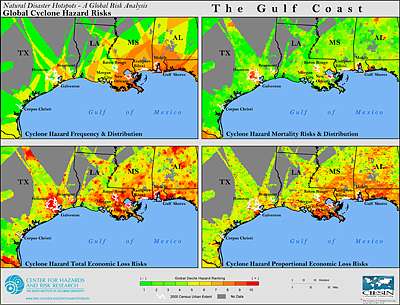
Hurricane Risk Map for the Northern and Western U.S. Gulf Coast

The Natural Disaster Hotspots report released earlier this year showed that the U.S. Gulf Coast is among the world's most at-risk regions in terms of human mortality and economic loss due to storms like Katrina and Rita.

The study, which was produced by researchers from the Center for Hazards and Risk Research, The International Research Institute for Climate Prediction (IRI), the Center for International Earth Science Information Network (CIESIN), the Lamont-Doherty Earth Observatory and the World Bank, estimated risk levels by combining hazard exposure with historical vulnerability for two indicators of elements at risk—gridded population and Gross Domestic Product (GDP) per unit area—for six major natural hazards: earthquakes, volcanoes, landslides, floods, drought and cyclones (which are called hurricanes in the North Atlantic and Eastern North Pacific).

By calculating relative risks for each grid cell rather than for countries as a whole, the study was able to estimate risk levels at sub-national scales. Such information can help inform a range of disaster prevention and preparedness measures, including prioritization of resources, targeting of more localized and detailed risk assessments, implementation of risk-based disaster management and emergency response strategies, and development of long-term land-use plans and multihazard risk management strategies.

Source: Center for Hazards and Risk Research

Explore further: Galaxies fed by funnels of fuel

add to favorites email to friend print save as pdf

Related Stories

Mexican volcano rumbles, but residents shrug it off

May 14, 2013

Mexico's Popocatepetl volcano has blown steam for days, prompting authorities to prepare for possible evacuations, but residents are used to their towering neighbor's rumblings and keep going to work without ...

The day NASA's Fermi dodged a 1.5-ton bullet (w/ video)

May 01, 2013

(Phys.org) —NASA scientists don't often learn that their spacecraft is at risk of crashing into another satellite. But when Julie McEnery, the project scientist for NASA's Fermi Gamma-ray Space Telescope, ...

Global networks must be redesigned, professor says

May 01, 2013

The increasing interdependencies between the world's technological, socio-economic, and environmental systems have the potential to create global catastrophic risks. We may have to redesign global networks, concludes Professor ...

Cuba faces vast land losses as sea levels rise

Apr 11, 2013

Cuba risks losing a vast stretch of beach front homes and pristine coastal habitat by 2050, because of rapidly rising sea levels, a top environmental official warned Thursday.

Recommended for you

Galaxies fed by funnels of fuel

11 hours ago

(Phys.org) —Computer simulations of galaxies growing over billions of years have revealed a likely scenario for how they feed: a cosmic version of swirly straws.

Dark, massive asteroid to fly by Earth on May 31

15 hours ago

It's 1.7 miles long. Its surface is covered in a sticky black substance similar to the gunk at the bottom of a barbecue. If it impacted Earth it would probably result in global extinction. Good thing it is ...

Source of life running out: water scientists

18 hours ago

The majority of people on Earth people will face severe water shortages within a generation or two if pollution and waste continues unabated, scientists warned at a conference in Bonn Friday.

Research team explains 'Lazarus' comets

18 hours ago

Astronomers from the University of Antioquia have discovered a graveyard of comets. These once-dormant comets, dubbed by astronomers as "The Lazarus comets," are now rejuvenated.

User comments : 0

More news stories

Galaxies fed by funnels of fuel

(Phys.org) —Computer simulations of galaxies growing over billions of years have revealed a likely scenario for how they feed: a cosmic version of swirly straws.

Source of life running out: water scientists

The majority of people on Earth people will face severe water shortages within a generation or two if pollution and waste continues unabated, scientists warned at a conference in Bonn Friday.

Dark, massive asteroid to fly by Earth on May 31

It's 1.7 miles long. Its surface is covered in a sticky black substance similar to the gunk at the bottom of a barbecue. If it impacted Earth it would probably result in global extinction. Good thing it is ...