Ancient rock star finds a home at the University of Alberta
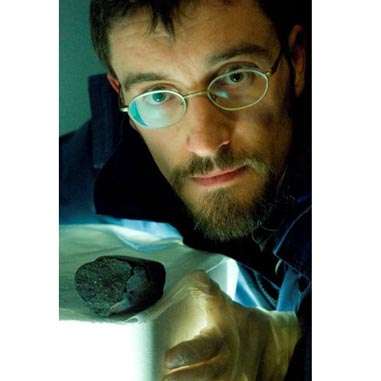
The University of Alberta is welcoming a very, very old rock star into its hallways. No, it's not Keith Richards. It is, perhaps, the most important rock on the face of the Earth.
The Tagish Lake meteorite is the only one of its kind known to exist on Earth, and may contain insights into the beginnings of our solar system, said Dr. Christopher Herd, a professor in the U of A Department of Earth and Atmospheric Sciences. Because the space-born rock fell on the frozen surface of a northern B.C. lake in the middle of January and was collected without being touched by human hands, it represents the most pristine sample of minerals from outer space.
"No other meteorite's ever been collected in this manner and I suppose that arguably makes it the most important rock that's ever been found anywhere on the Earth," said Herd. "It can tell us new information about the birth and evolution of our solar system, and the very fact that it's been kept frozen, essentially pristine, uncontaminated by human hands, gives us an unprecedented opportunity to explore new scientific avenues that were heretofore impossible. We can do things with this meteorite that nobody's ever done before."
The Tagish Lake meteorite is being carefully stored in sub-zero conditions in the U of A's meteorite collection and has never been in temperatures above freezing. It was formed in space, protected from the heat of re-entry by a crust of minerals, and landed during a northern Canadian winter.
"What that means is that we can look for minerals in there that are not normally preserved under normal circumstances, where they're collected above freezing," said Herd. "It has actually been reported that for some of these meteorites, when they're warmed up, you actually can smell kind of sulphurous smells or metallic smells as the volatile components are kind of de-gassing. So, it gives us an opportunity to look at this when those volatile components are still there. It even provides us the opportunity to look for extraterrestrial ices. I mean, who knows whether they're there, but we can look because of the way this thing's been collected."
The other thing that makes this meteorite so special is its composition. It's an extremely rare type of formation that has preserved the goings-on of more than 4.57 billion years ago. Of all the meteorites that fall to Earth, only two or three per cent are of the same category as the Tagish Lake stone, said Herd.
"The meteorite is a carbonaceous chondrite, which is quite a rare type of meteorite. These meteorites represent the left-over material from the formation of the solar system," he said. "This is in the broader context for the theories that we have for the formation of the solar system, which is that the planets formed from a rotating disk of dust and gas around the early sun. So, this material is left over from that. It's basically a sampling of the dust and gas that were present in that disk before the planets started to form."
The meteorite came to the U of A through a partnership between the university, Canadian Heritage, the Royal Ontario Museum, Natural Resources Canada and the Canadian Space Agency.
"We are also very fortunate to have a group of very passionate and dedicated scientists who have worked on this project for many years to ensure that it comes to this institution as well as the others," said Janine Andrews, executive director of the University of Alberta Department of Museums and Collections Services.
For Herd, this is the something he's been waiting a long time for.
"Shortly after I started here three years ago, I thought this would be a great meteorite to have because of its scientific value. It also fell in Canadian territory. It's a Canadian meteorite and it really needed to be in a Canadian institution in order to maximize the science and to demonstrate that we could do great science on this," he said.
"So, it means a lot. I'm not going to do everything; I can't do everything on this. It will be a matter of setting up a research consortium with other researchers across Canada, with input from researchers around the world, who are all eager to work on this as well - to really tease out as much as we can about the formation of the solar system."
Source: University of Alberta


