Drilling on Mars to find evidence of ancient organisms: a second genesis of life?

Sep 15, 2005 feature
Drilling on Mars to find evidence of ancient organisms: a second genesis of life?
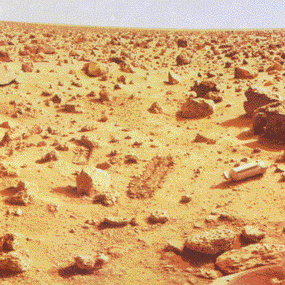
Was there ever life on Mars? The answer to this question would do more than just satisfy curiosity. Researchers from NASA announce a plan to drill on Mars in search of ancient Martian organisms for comparison between life on Mars and life on Earth.

It is already theorized that life on Earth shares a common ancestor with life on Mars brought about by an exchange of material from meteorites. Evidence of life on Mars would strengthen this theory and give insight to origins of life on Earth.

Current research has focused on attaining fossils of Martian life which would only prove that life once existed on the planet. However, scientists from NASA and the SETI Institute believe that they can find out more information from Martian permafrost.

If researchers could discover dead, but intact organisms from Mars, biochemical and genetic analysis could be performed. These methods would provide a way for direct comparison between the life once found on Mars and the life currently found on Earth.

The best place to look for preserved Martian organisms is in the permafrost found on the Southern hemisphere of Mars. Heavily cratered, this terrain dates back to early Martian history when water was abundant and existence of life more likely.

Scientists at NASA have several obstacles to overcome as they plan this study. Mars is under strict planetary protection laws set forth by the Committee on Space Research (COSPAR). Any robotic drilling missions would need to utilize sterile equipment to avoid introducing biological material into the Martian environment.

Also, contamination of samples must be avoided to ensure that biological material taken from the permafrost was of Martian origin.

Before a drilling mission to Mars is underway, more research is needed to develop automated drilling systems or systems for human operation.

In the near future though, NASA hopes to find evidence of life on Mars. Could this evidence represent a second genesis of life, separate from that on Earth? The answers may be in the permafrost.

Reference:

Smith HD and McKay CP.
Planetary and Space Science Journal. 2005. Article in Press.

by Gina M. Buss, Copyright 2005 PhysOrg.com

Explore further: Could pond waste be the 'new' fertiliser?

add to favorites email to friend print save as pdf

Related Stories

Mars rover Opportunity examines clay clues in rock

May 18, 2013

(Phys.org) —NASA's senior Mars rover, Opportunity, is driving to a new study area after a dramatic finish to 20 months on "Cape York" with examination of a rock intensely altered by water.

Mars Icebreaker Life mission

May 16, 2013

Missions to Mars have only scratched its surface. To go deeper, scientists are proposing a spacecraft that can drill into the Red Planet to potentially find signs of life.

How to plant a garden on Mars—with a robot

May 15, 2013

In the last century humanity has taken gigantic leaps forward in the robotic exploration of the cosmos—not least in the search for habitable worlds and environments that could house life outside of the ...

Recommended for you

Forecast for Titan: Wild weather could be ahead

7 minutes ago

(Phys.org) —Saturn's moon Titan might be in for some wild weather as it heads into its spring and summer, if two new models are correct. Scientists think that as the seasons change in Titan's northern hemisphere, ...

NASA's Landsat satellite looks for a cloud-free view

21 minutes ago

For decades, Landsat satellites have documented the desiccation of the Aral Sea in Central Asia. Once one of the largest seas in the world, it shrunk to a tenth of its original volume after Russia diverted ...

SDO observes mid-level solar flare

28 minutes ago

UPDATE 16:30 p.m. EDT: The M7-class flare was also associated with a coronal mass ejection or CME, another solar phenomenon that can send billions of tons of particles into space. While this CME was not Ea ...

User comments : 0

More news stories

Forecast for Titan: Wild weather could be ahead

(Phys.org) —Saturn's moon Titan might be in for some wild weather as it heads into its spring and summer, if two new models are correct. Scientists think that as the seasons change in Titan's northern hemisphere, ...

SDO observes mid-level solar flare

UPDATE 16:30 p.m. EDT: The M7-class flare was also associated with a coronal mass ejection or CME, another solar phenomenon that can send billions of tons of particles into space. While this CME was not Ea ...

NASA's Landsat satellite looks for a cloud-free view

For decades, Landsat satellites have documented the desiccation of the Aral Sea in Central Asia. Once one of the largest seas in the world, it shrunk to a tenth of its original volume after Russia diverted ...