Building a hand-held lab-on-a-chip to simplify blood tests
April 11, 2006

Building a hand-held lab-on-a-chip to simplify blood tests

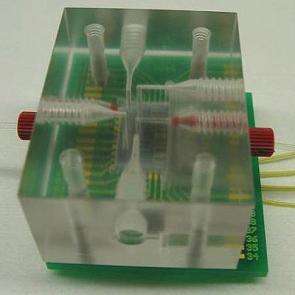
The lab-on-a-chip is a miniaturized, portable version of a blood-count machine. On long missions, astronauts will need the ability to analyze blood samples in real-time to diagnose infection, allergies, anemia or deficiencies in the immune system. Credit: Photo courtesy of Y. Tai, California Institute of Technology

A cell phone-sized blood-count machine requiring less blood than a mosquito bite will make blood tests easier for many patients, from neonatal units to astronauts in space.

Funded by the National Space Biomedical Research Institute (NSBRI), researchers at the California Institute of Technology, the University of California, Los Angeles, and IRIS International, Inc., are working to create a hand-held device that provides accurate appraisals of blood chemistry using minute blood samples. The process takes about two minutes.

"Analysis of blood composition is how doctors test for infections and deficiencies in the immune system, monitor health and make medical diagnoses," said Dr. Yu-Chong Tai, investigator on NSBRI's Technology Development Team. "Looking ahead to future missions to the moon and Mars, astronauts will need to perform simple blood tests to get up-to-the-minute information on their health."
Building a hand-held lab-on-a-chip to simplify blood tests

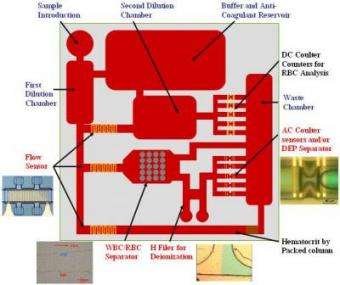
Dr. Tai and his collaborators designed micro-sized valves, pumps and flow chambers that operate and fit together in the lab-on-a-chip. The tiny device requires less than a drop of blood in order to identify components such as red and white blood cells, lipids, proteins or oxygen molecules. Credit: Image courtesy of Y. Tai, California Institute of Technology.

Presently, the slow process of assessing blood composition requires bulky counting machines, trained technicians and a large amount of blood (approximately two syringes or ten milliliters), so analysis cannot be done in space. To assess their physiology, astronauts draw blood samples in orbit for analysis after their return. "In addition to space medicine, the technology could be used in neonatal care since large blood draws are not possible with infants," Tai added.

"Normal blood-count machines are large to accommodate many samples and multiple tests, so to be safe, technicians take more blood from a patient than is actually needed. Since our goal is to assess blood composition on a molecular level, we only need a tiny amount," said Tai, professor of electrical engineering and bioengineering at Caltech. "By miniaturizing the counting machine, we're able to take a smaller sample, making the device a portable tool for space flight and in clinical settings."

The blood-count machine will separate and identify components of blood such as red and white blood cells, lipids, proteins or oxygen. Working with IRIS International, Inc., a maker of digital diagnostic systems, Tai was able to build micro-sized valves, pumps and flow chambers that operate and fit together in the lab-on-a-chip. "Only a drop of blood is needed on the tip of the chip," Tai said.

The blood sample is pulled into a mixing chamber where anti-coagulation chemicals are injected. Because blood has a dense population of cells, the sample then travels to a reservoir where a solution dilutes the concentration by two or three times. The sample then goes to a cell separator that divides molecules based on size.

"In this case, white blood cells will be separated from red blood cells. Because of fluid dynamics, larger molecules like white blood cells will bypass a chamber that they can't fit into and flow into the space where they do, thus separating the blood cell types," he said.

The cell separator puts space between molecules so that they flow easily into the counter. In large blood-count machines, cells are calculated by a technology called a Coulter counter. Tai's lab-on-a-chip device is pioneering new technology by using two separate-yet-parallel micro-Coulter counters to calculate white blood cells and red blood cells independently.

Tai and his colleagues plan to expand the technology to assess a variety of molecules in addition to blood, add the ability to measure fluids like plasma and urine, or incorporate cell surface marker and DNA analysis.

"The chip can be designed for many applications. The miniaturized cell-counter has potential as a diagnostic tool for cancer detection by searching in plasma for certain biomolecules that could be early indicators," Tai said. "Science has dictated that all of these things can be done, we've just needed to develop the technology."

Source: National Space Biomedical Research Institute

4.2 /5 (9 votes)  

Rank 4.2 /5 (9 votes)
Tags

Relevant PhysicsForums posts

More news stories

Change in developmental timing was crucial in the evolutionary shift from dinosaurs to birds: study

At first glance, it's hard to see how a common house sparrow and a Tyrannosaurus Rex might have anything in common. After all, one is a bird that weighs less than an ounce, and the other is a dinosaur that ...

Other Sciences / Archaeology & Fossils

created 10 hours ago | popularity 5 / 5 (8) | comments 0 | with audio podcast

Social welfare cuts ultimately come with heavy price, researchers say

(Phys.org) -- Slashing government funding for Medicaid, food stamps and other programs that serve the poor – while politically popular with some lawmakers and many conservatives – may do more harm ...

Other Sciences / Social Sciences

created May 24, 2012 | popularity 4.1 / 5 (22) | comments 156

Ancient Bethlehem seal unearthed in Jerusalem

Israeli archaeologists have discovered a 2,700-year-old seal that bears the inscription "Bethlehem," the Israel Antiquities Authority announced Wednesday, in what experts believe to be the oldest artifact ...

Other Sciences / Archaeology & Fossils

created May 23, 2012 | popularity 3.3 / 5 (15) | comments 24

Dollars and sense: Why are some people morally against tax?

As the U.S. presidential election campaigns heat up, the economic debate is dominated by bailouts, austerity and, inevitably, taxation. Now a new study published in Symbolic Interaction asks why tax is such an important issue ...

Other Sciences / Social Sciences

created May 23, 2012 | popularity 2.3 / 5 (3) | comments 20

Oldest Jewish archaeological evidence on the Iberian Peninsula

German archaeologists of the Friedrich Schiller University Jena found one of the oldest archaeological evidence so far of Jewish Culture on the Iberian Peninsula at an excavation site in the south of Portugal, ...

Other Sciences / Archaeology & Fossils

created May 25, 2012 | popularity 4.2 / 5 (6) | comments 12


'Unzipped' carbon nanotubes could help energize fuel cells, batteries

Multi-walled carbon nanotubes riddled with defects and impurities on the outside could replace some of the expensive platinum catalysts used in fuel cells and metal-air batteries, according to scientists at ...

Computer model used to pinpoint prime materials for efficient carbon capture

When power plants begin capturing their carbon emissions to reduce greenhouse gases – and to most in the electric power industry, it's a question of when, not if – it will be an expensive undertaking.

T cells 'hunt' parasites like animal predators seek prey, study shows

By pairing an intimate knowledge of immune-system function with a deep understanding of statistical physics, a cross-disciplinary team at the University of Pennsylvania has arrived at a surprising finding: T cells use a movement ...

Stunning image of smallest possible five-ringed structure

Scientists have created and imaged the smallest possible five-ringed structure – about 100,000 times thinner than a human hair – and you'll probably recognise its shape.

Land and sea species differ in climate change response: study

(Phys.org) -- Marine and terrestrial species will likely differ in their responses to climate warming, new research by Simon Fraser University and Australia’s University of Tasmania has found.

Yale study concludes public apathy over climate change unrelated to science literacy

Are members of the public divided about climate change because they don't understand the science behind it? If Americans knew more basic science and were more proficient in technical reasoning, would public consensus match ...