Big breakthrough for tiny particles
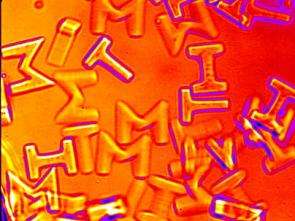
MIT chemical engineers have devised an elegant new method for creating complex polymeric microparticles that could have applications in a variety of fields, from drug delivery in medicine to the creation of building blocks for the photonic materials that carry light. The particles can also add texture to skin creams and color to inks.
The new synthesis method gives researchers an extraordinary degree of control over the shape and chemical properties of the microparticles, which range in size from about 1 millionth of a meter to a millimeter.
"We have precise control over shape and an ability to create patterned chemical regions, that is rather unprecedented," said Assistant Professor Patrick Doyle of chemical engineering, one of the authors of a report appearing in the online edition of Nature Materials on April 9.
Doyle says he hopes other researchers will adopt his team's new technique of continuous flow lithography (CFL), which allows for faster, easier production of microparticles of diverse shape, size and chemical composition.
CFL builds on the well-known technique of photolithography but its novelty lies in the fact that it is performed in a laminar (not turbulent) flowing stream as opposed to the traditionally used stationary film. Wherever pulses of ultraviolet light strike the flowing stream of small building blocks, or oligomers, a reaction is set off that forms a solid polymeric particle in a process known as photopolymerization.
The method makes use of microfluidics - tiny fluid-filled channels with cross-sections typically smaller than a strand of hair. Until now, microfluidic methods have been limited to producing spheres, discs or cylinders. However, with CFL, the particles can be configured into just about any projected 2D shape the researchers want by using a transparency mask to define the shape of a beam of ultraviolet light and focusing it with a microscope. As liquid flows through a microfluidic device, where the synthesis occurs, the shape is repeatedly imprinted onto the oligomer stream, at a rate of about 100,000 particles per hour with the current simple design.
"From an engineering point of view, converting a batch process (photolithography) to a continuous process may have significant advantage when we consider scaling up the technique," said graduate student Dhananjay Dendukuri, lead author on the paper.
The researchers can also create particles with different chemical properties in different locations - for example, a rod that is hydrophilic (water-loving) at one end and hydrophobic (water-fearing) at the other. Such particles are examples of so-called Janus particles, after the Roman god with a double-faced head, and may find use in e-paper technologies or as new building blocks for self-assembled structures.
The new method also makes it easier to create "barcoded" particles, which have an array of chemical properties in different locations. Instead of adding "stripes," or chemical properties, one at a time, the new technique allows them all to be added at once, said Doyle.
Potential medical applications for such particles include drug delivery and performing diagnostic tests, such as testing blood for the presence of certain antibodies or other proteins. Graduate student Daniel Pregibon, one of the authors, said he is interested in creating ring-shaped particles, or "cell cages," that would trap cells for high throughput single cell studies.
Other authors on the paper are Alan Hatton, Ralph Landau Professor of Chemical Engineering Practice, and senior physics major Jesse Collins.
The research was supported by a National Science Foundation grant.
Source: MIT


