Tracking the Riddle of Cosmic Gamma Rays

Aug 23, 2005
the

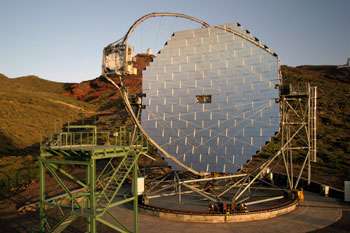
First simultaneous observation of a gamma-ray burst in the X-ray and in the very high energy gamma ray band.For the first time a gamma-ray burst (GRB) has been observed simultaneously in the X-ray and in the very high energy gamma ray band. The MAGIC telescope at La Palma, Canary Islands, observed the enigmatic source GRB050713A, a long duration gamma-ray burst, only 40 seconds after the explosion, at photon energies above 175 GeV.
The puzzling nature of gamma-ray bursts is still not fully understood. Sometimes, GRBs are accompanied by photons 10 billion times more energetic than visible light, lasting typically less than a few tens of seconds. They are among the most distant and luminous sources in the Universe.

The capability of rapid tracking of the MAGIC telescope allowed the operators to start observing the source 20 seconds after the alert was given by the Swift satellite, which is in the Gamma ray bursts Coordinates Network, when the burst was still active in the X-ray range.

The first look at the MAGIC data did not reveal strong gamma ray emissions above 175GeV. The flux limit derived at very high energies by MAGIC is extremely low, 2-3 orders of magnitude lower than the extrapolation from lower energies. A detailed analysis is in progress. The upper limit for the flux of energetic gamma rays is consistent with the expected flux of a GRB at high red-shift, strongly attenuated by cosmological pair production. These observations were reported at the 29th International Cosmic Ray Conference which was held on August 3-10 in Pune, India

With its 240 square meters surface, MAGIC is the largest telescope in the world dedicated to the detection of gamma rays. It is managed by a collaboration of 17 institutes from Germany, Italy, Spain, Switzerland, Finland, USA, Poland, Bulgaria and Armenia. The Gamma ray bursts Coordinates Network, managed by NASA, can distribute locations of GRBs detected by spacecrafts (Swift, Hete, Integral, Ipn, etc.) and reports of follow-up observations made by ground-based and space-based optical, radio, and x-ray observers.

Source: Max Planck Institute of Physics

Explore further: Slovenian flyer lands in France on return trip from Arctic

add to favorites email to friend print save as pdf

Related Stories

Making gold green: New non-toxic method for mining gold

May 14, 2013

Northwestern University scientists have struck gold in the laboratory. They have discovered an inexpensive and environmentally benign method that uses simple cornstarch—instead of cyanide—to isolate gold from raw materials ...

The MAGIC-II Telescope is ready to team up

Apr 15, 2009

(PhysOrg.com) -- Together with the MAGIC-I telescope, MAGIC-2 allows stereoscopic observations using these two largest gamma-ray telescopes. Astronomers can explore sources of very-high energy gamma rays. ...

Unexpected source of gamma rays discovered

Mar 06, 2009

An international team of astrophysicists, involving several research groups in Spain, has discovered a source of very high energy gamma rays in the region of the distant galaxies 3C 66A and 3C 66B. This new ...

Are we closing in on dark matter?

Dec 18, 2012

As the search for dark matter intensifies, the Kavli Institute for Cosmological Physics at the University of Chicago and the National Academy of Sciences organized a colloquium that brings together cosmologists, ...

Recommended for you

Galaxies fed by funnels of fuel

5 hours ago

(Phys.org) —Computer simulations of galaxies growing over billions of years have revealed a likely scenario for how they feed: a cosmic version of swirly straws.

Dark, massive asteroid to fly by Earth on May 31

9 hours ago

It's 1.7 miles long. Its surface is covered in a sticky black substance similar to the gunk at the bottom of a barbecue. If it impacted Earth it would probably result in global extinction. Good thing it is ...

Source of life running out: water scientists

12 hours ago

The majority of people on Earth people will face severe water shortages within a generation or two if pollution and waste continues unabated, scientists warned at a conference in Bonn Friday.

Research team explains 'Lazarus' comets

12 hours ago

Astronomers from the University of Antioquia have discovered a graveyard of comets. These once-dormant comets, dubbed by astronomers as "The Lazarus comets," are now rejuvenated.

User comments : 0

More news stories

Galaxies fed by funnels of fuel

(Phys.org) —Computer simulations of galaxies growing over billions of years have revealed a likely scenario for how they feed: a cosmic version of swirly straws.

Dark, massive asteroid to fly by Earth on May 31

It's 1.7 miles long. Its surface is covered in a sticky black substance similar to the gunk at the bottom of a barbecue. If it impacted Earth it would probably result in global extinction. Good thing it is ...

Source of life running out: water scientists

The majority of people on Earth people will face severe water shortages within a generation or two if pollution and waste continues unabated, scientists warned at a conference in Bonn Friday.

Google eyes emerging markets networks

Google has become deeply involved in a series of projects to build and operate wireless networks in emerging markets including sub-Saharan Africa and Southeast Asia, a report said Friday.