Swift Satellite Finds Newborn Black Holes
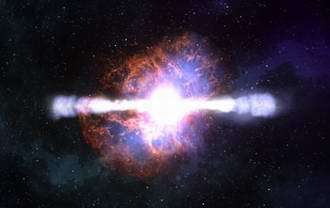
Scientists using NASA's Swift satellite say they have found newborn black holes, just seconds old, in a confused state of existence. The holes are consuming material falling into them while somehow propelling other material away at great speeds.
These black holes are born in massive star explosions. An initial blast obliterates the star, yet the chaotic black hole activity appears to re-energize the explosion several times in just a few minutes. This is a dramatically different view of star death, one that entails multiple explosive outbursts and not just a single bang, as previously thought.
"Stars are exploding two, three and sometimes four times in the first minutes following the initial explosion," said Prof. David Burrows of Penn State, University Park, Pa. "First comes a blast of gamma rays followed by intense pulses of X-rays. The energies involved are much greater than anyone expected," he added.
Scientists have seen this phenomenon in nearly half of the longer gamma-ray bursts detected by Swift. These gamma-ray bursts are the most powerful explosions known. They are forerunners of a massive star explosion called a hypernova, which is bigger than a supernova. Using Swift, scientists are finally able to see gamma-ray bursts within minutes after the trigger, instead of hours or days, and are privy to newborn black hole activity.
Until this latest Swift discovery, scientists assumed a simple scenario of a single explosion followed by a graceful afterglow of the dying embers. The new scenario of a blast followed by a series of powerful "hiccups" is particularly evident in a gamma-ray burst from May 2, 2005, named GRB 050502B. This burst lasted 17 seconds during the early morning hours in the constellation Leo. About 500 seconds later, Swift detected a spike in X-ray light about 100 times brighter than anything seen before.
Previously there had been hints of an "X-ray bump" between the burst and afterglow in previous gamma-ray bursts, coming a minute or so after the burst. Swift has seen more than one dozen clear cases of multiple explosions. There are several theories to describe this newly discovered phenomenon and most point to the presence of a newborn black hole.
"The newly formed black hole immediately gets to work," said Prof. Peter Meszaros of Penn State, head of the Swift theory team. "We aren't clear on the details yet, but it appears to be messy. Matter is falling into the black hole, which releases a great amount of energy. Other matter gets blasted away from the black hole and flies out into the interstellar medium. This is by no means a smooth operation," he added.
Another theory is the jet of material shooting away from the dead star starts to fall back onto itself, creating shockwaves in the jet core that ram together blobs of gas and produce X-ray light.
"None of this was realized before simply because we couldn't get to the scene of the explosion fast enough," said Dr. Neil Gehrels of NASA Goddard Space Flight Center, Greenbelt, Md., Swift principal investigator. "Swift has the unique ability to detect bursts and turn its X-ray and ultraviolet-optical telescopes to the explosion's embers within minutes. As such, Swift is detecting new burst details that might rewrite theory," Gehrels said.
Swift carries three main instruments: the Burst Alert Telescope (BAT); X-ray Telescope (XRT); and the Ultraviolet/Optical Telescope (UVOT). Today's announcement is based largely on XRT data. The XRT was built at Penn State with partners at the Brera Astronomical Observatory in Italy and the University of Leicester in England.
Swift was launched in November 2004. It is a NASA mission in partnership with the Italian Space Agency and the Particle Physics and Astronomy Research Council, United Kingdom. Swift is managed by Goddard. Penn State controls science and flight operations from the Mission Operations Center in University Park, Pa. The spacecraft was built in collaboration with national laboratories, universities and international partners.
A paper discussing these findings appears online today on Science Express and in the September 9 issue of Science. Burrows is lead author of the paper.
Source: NASA


