Manitoba meteorite hunter scores again
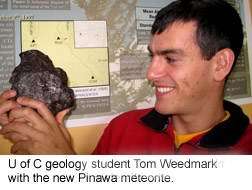
A new meteorite identified by the Prairie Meteorite Search is posing a mystery about why so many meteorites have been found in eastern Manitoba, and has set a new Canadian record for the man behind the latest out-of-this-world find.
Winnipeg-based rock hound Derek Erstelle has become the first person in Canada to discover two separate meteorites after he uncovered a previously-overlooked meteorite while sifting through some of the unusual rocks he has collected over the years.
After finding two fragments of an iron meteorite in the fall of 2002 near Bernic Lake, in eastern Manitoba, Erstelle decided to dig out a similar-looking specimen he discovered about 40-kilometres away near Pinawa in 1998 or 1999.
Tests conducted by U of C planetary scientist Dr. Alan Hildebrand and Lakehead University's Dr. Stephen Kissin confirmed that the Pinawa specimen is a rock from outer space and originated from a different source than the Bernic Lake specimens.
"I was inspired to look through my stored rocks for this other rock that I had found before the Bernic Lake specimens,"said Erstelle, who is an experienced rock collector. "I'm just out there knocking dust off the rocks when I'm out hunting."
The Pinawa meteorite is the 7th meteorite to be recovered in Manitoba, and is the 4th Manitoba 'find' to be identified by the Prairie Meteorite Search. Meteorites are broadly classified as being either 'falls' corresponding to meteorites that were seen to fall to Earth, and 'finds' which correspond to meteorites found serendipitously, but with unknown fall dates. The meteorite weighs approximately 2.5 kg and is the 65th meteorite to be recovered in Canada.
Hildebrand, holder of a Canada Research Chair in Planetary Sciences, calls the discovery very surprising. The extraordinary thing is that two different meteorites could be found only 40 kilometres apart in forested land, where it is much more difficult to find them than on farm or pasture land. Also, the two meteorites are more weathered than is typical for Canadian iron meteorites.
"The meteorite looked much like the two Bernic Lake meteorites so, although they were found about 40-kilometres apart, I still expected them to be related. We have the makings of a puzzle here."Hildebrand said.
The discovery of more than one meteorite in the same area may be evidence that many meteorites were deposited in eastern Manitoba when glaciers retreated from Western Canada at the end of the last Ice Age.
"The area where Derek found these meteorites is where two lobes of the Laurentide ice sheet met about 11,500 years ago,"Hildebrand said. "He may have located a meteorite stranding surface where hundreds or thousands of meteorites were concentrated by glacial flow and were dumped in a small area when the ice melted."
Hildebrand said this theory can be tested by determining how long the Bernic Lake and Pinawa meteorites have been on Earth, and by searching for more meteorites in the region near Pinawa.
Tom Weedmark, a U of C geology student, is the Prairie Meteorite Searcher for the summer of 2005. This field campaign locates meteorites by encouraging prairie residents to have rocks identified that they suspect may be meteorites.
The project consists of local publicity and visits by Tom to prairie towns to show meteorite specimens and to identify possible meteorites. He will be looking in northern Alberta for the rest of July before heading east to Saskatchewan and Manitoba during August.
"The continued success of the search indicates that many more prairie residents have meteorites that haven't yet been studied,"Weedmark says. "I hope that we can make this Centennial year a record year for meteorite recovery in Canada."
The Prairie Meteorite Search is led by Hildebrand, Dr. Peter Brown from the University of Western Ontario and Dr. Martin Beech from Campion College at the University of Regina.
They are all members of the Meteorites and Impacts Advisory Committee (MIAC) to the Canadian Space Agency. MIAC is Canada's volunteer group charged with the investigation of fireballs and the recovery of meteorites. The Canadian Space Agency is funding much of the project's field costs for the summer of 2005.
Source: University of Calgary


