Sharp Develops New Technology to Blend Plant-Based Plastic with Waste Plastic

Jul 11, 2005

Sharp Corporation has developed a new technology to blend plant-based plastic that uses corn as the raw material, and waste plastic recovered from scrapped consumer electronics.
Using a mix of plant-based plastic and waste plastic blended by means of this technology in consumer electronics can significantly reduce environmental impact compared to using common plastics derived from petroleum-based feedstocks.

In the future, Sharp will be conducting tests to assess commercial potential, with the goal of using blended plastic in Sharp products within fiscal 2006. In the future, when the price of plant-based plastics is reduced to a level on a par with general plastics, it is estimated that the percentage of renewable resources (plant-based plastic and waste plastic) used in all products will increase to 30% by fiscal 2010.

At present, raw materials used in consumer electronics rely almost entirely on fossil materials such as petroleum, but efforts to shift as much as possible to renewable resources (plant-based and recycled materials) are moving forward from the perspective of limiting emissions of greenhouse gases, with the aim of building a sustainable recycling-oriented society.

At the same time, plant-based plastics have the potential to reduce the impact on the environment given that incinerating these materials does not cause the concentration of carbon dioxide gas in the atmosphere to rise. However, problems remain in terms of impact/shock resistance, thermal resistance, cost and other factors, and their adoption in the area of consumer durable goods, particularly electronic products, remains limited.

Against this background, Sharp has been conducting research since 1999 on technologies to recycle waste plastic from consumer electronics, and in May 2003, put such a recycling technology into practical use to enable repeated re-use of polypropylene (PP) and polystyrene (PS) recovered from four categories of discarded household electrical appliances falling under the Home Appliance Recycling Law (air conditioners, TVs, refrigerators and washing machines) in components in new manufactured products in these four categories without loss of physical properties such as material strength.

Major Features of Technology to Blend Plant-Based Plastics and Waste Plastic

1) Development of technology to compatibilize*1 plant-based plastic with waste plastic.
2) Improved impact resistance, thermal resistance, etc., to a practical level, previously a problem with plant-based plastic.
3) Three patent applications pending.

*1 Technology to cause microdispersion (increase compatibility at the molecular level) by uniformly blending non-homogeneous plastic materials.

Technology to Compatibilize Plant-Based Plastic with Waste Plastic

In blending plant-based plastic (polylactic acid [PLA]) and waste plastic (polypropylene [PP]), the two materials tend not to be mutually compatible, causing a gap to form at the boundary surfaces of the PLA and PP and leading to a significant loss of physical properties (such as impact resistance and thermal resistance) (see Figure 1).

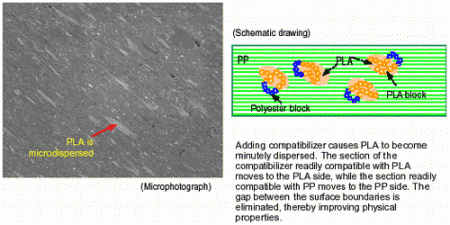
But blending in an appropriate amount of a newly developed compatibilizer (Figure 2) and mixing the PLA and PP in an optimal proportion, the PLA forms an ultrafine dispersion and facilitates compatibility between the two materials, thereby dramatically improving the physical properties of the blended material. (Figure 3).
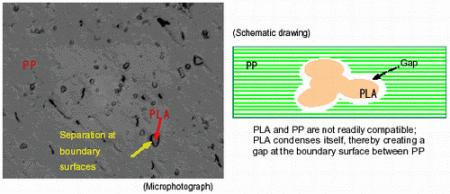

Figure 1 When PLA and PP are mixed using typical methods

Figure 2   Schematic diagram of compatibilizer at work
Figure 2 Schematic diagram of compatibilizer at work

Figure 3. PLA is microdispersed as a result of blending with a compatibilizer


Explore further: Yahoo! to buy blog-maker Tumblr for $1.1 billion: report

add to favorites email to friend print save as pdf

Related Stories

Australian continent takes a big drink

1 minute ago

(Phys.org) —Devastating at the time, the major floods of 2011 have since brought a vital benefit by recharging Australia's depleted reserves of underground water.

Bovine blood keeps gold nanoparticles stable

11 minutes ago

(Phys.org) —A protein from cow blood has the remarkable ability to keep gold nanoparticles from clumping in a solution. The discovery could lead to improved biomedical applications and contribute to projects ...

From ocean to land: The fishy origins of our hips

28 minutes ago

New research has revealed that the evolution of the complex, weight-bearing hips of walking animals from the basic hips of fish was a much simpler process than previously thought.

Why don't beetles freeze in the winter?

33 minutes ago

For 37 years, Queen's University Biochemistry professor Peter Davies has been unraveling the mystery of why some organisms including insects and fish don't freeze in the winter. His research into insect antifreeze protein ...

Recommended for you

German energy shift faces headwinds

12 hours ago

Tense engineers have their eyes peeled on complex colour-coded diagrams on a wall-sized screen that makes their control room look like the inside of a spaceship.

China police billions spell profit opportunity

12 hours ago

Mannequins in riot gear, armoured cars and drones line a police equipment and "anti-terrorism technology" trade fair in Beijing as vendors seek to profit from China's huge internal security budget.

Internet in 'coma' as Iran election looms

13 hours ago

Iran is tightening control of the Internet ahead of next month's presidential election, mindful of violent street protests that social networkers inspired last time around over claims of fraud, users and ...

Pakistan adopts Chinese rival GPS satellite system

May 18, 2013

Pakistan is set to become the fifth Asian country to use China's domestic satellite navigation system which was launched as a rival to the US global positioning system, a report said Saturday.

User comments : 0

More news stories

German energy shift faces headwinds

Tense engineers have their eyes peeled on complex colour-coded diagrams on a wall-sized screen that makes their control room look like the inside of a spaceship.

Internet in 'coma' as Iran election looms

Iran is tightening control of the Internet ahead of next month's presidential election, mindful of violent street protests that social networkers inspired last time around over claims of fraud, users and ...

China police billions spell profit opportunity

Mannequins in riot gear, armoured cars and drones line a police equipment and "anti-terrorism technology" trade fair in Beijing as vendors seek to profit from China's huge internal security budget.

Heat-related deaths in Manhattan projected to rise

Residents of Manhattan will not just sweat harder from rising temperatures in the future, says a new study; many may die. Researchers say deaths linked to warming climate may rise some 20 percent by the 2020s, ...

Kinks and curves at the nanoscale

One of the basic principles of nanotechnology is that when you make things extremely small—one nanometer is about five atoms wide, 100,000 times smaller than the diameter of a human hair—they are going ...