Sony Extends AIT Format to A Fourth Generation with 200GB AIT-4
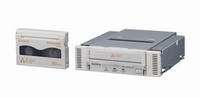
200GB AIT-4 Drives Emphasize Storage Capacity, Performance, Reliability, and Functionality in a Compact Form-Factor
Sony Electronics has extended its Advanced Intelligent Tape(TM) (AIT) format to a fourth-generation drive, strengthening the comprehensive format's ability to satisfy storage needs from small business data protection to enterprise back up.
With a compact 3.5-inch drive form-factor and a small 8mm media format, AIT-4 drives and media fulfill Sony's aggressive commitment to double storage capacity and transfer rates from one AIT generation to the next. The drives feature up to 200GB of native storage capacity (520GB with 2.6:1 compression) and a sustained native transfer rate of up to 24 MB/second.
"AIT-4 technology establishes new AIT format milestones for both capacity and performance on the AIT technology roadmap," said Hiroyuki Minamiya, senior marketing manager for Sony Electronics' Tape Storage Division. "The format will continue to evolve to stay ahead of the needs of small business users and to keep pace with ever-expanding data storage needs of enterprise departments. AIT-4 is the highest density tape drive in the world, allowing our customers to manage fewer tapes and conserve space."
Sony continues to enhance the AIT format with every generation, and has outlined a future roadmap that includes up to a sixth generation member before the end of the decade. The company has also realized its goal for backward read/write compatibility with each previous generation of media. AIT-4 drives are backward read/write compatible with AIT-3 media, and read compatible with AIT-2 and AIT-1 media.
Industry Response
"Companies of all shapes and sizes can turn to Sony AIT drives to effectively meet their data backup, archiving and disaster recovery needs," said Bob Abraham, president of Freeman Reports. "With four generations of drives now available, AIT is poised to handle a spectrum of storage needs, from DDS migration for the SMB market, all the way up to enterprise-level data centers."
"Tape continues to be a desirable format for backup and archival storage, and companies continue to demand a tape product with reliability, speed, and high capacity at an affordable price point" said Fara Yale, Research Vice President at Gartner Dataquest. "Government regulations also continue to place additional requirements on organizations to store and retain critical records on non-alterable media, so tape vendors have an expanded opportunity to offer affordable write-once solutions to meet these requirements."
"With the introduction of the AIT-4 tape drive, Sony continues to execute on the AIT roadmap," said Robert Amatruda, research manager for tape and removable storage at IDC. "The AIT-4 drive's 3.5-inch form-factor and high capacity make it well-suited for customers who place a premium on storage density and space - particularly in tape libraries."
"AIT-4's speed, capacity and reasonable price keeps 8mm competitive against half-inch tape formats," said Nathan Thompson, chief executive officer of Spectra Logic Corporation. "Spectra Logic, with 15,000 AIT tape libraries installed today, will further expand its AIT market share and increase enterprise sales with AIT-4."
"With its compelling combination of capacity and performance, AIT-4 tape technology demonstrates the extensibility of AIT technology," said Bob Covey, vice president of marketing for Qualstar. "Qualstar looks forward to delivering enterprise-class automation solutions based on AIT-4 to meet the continuous storage demands of our customers."
About AIT Technology
AIT technology reflects Sony's 50 years of innovation and technical excellence in meeting customers' needs through magnetic recording solutions. AIT-4 technology is characterized by 8mm media, a compact 3.5-inch drive form- factor, helical-scan recording, Advanced Metal Evaporated II media, a unique Remote-Memory-In-Cassette chip and advanced read/write head technology.
* Advanced Metal Evaporated II (AME II) Tape -- AIT-4 media is based on
AME II technology, which enables the media's extraordinary areal
recording density, as well as its high durability. AME II improves upon
its predecessor, AME, with a new method for applying the magnetic layer
to the tape, an enforced coating layer, and a newly developed lubricant
for stable operation. AME II media realizes high output and low noise
through an improved metal evaporated method resulting in smaller
magnetic particles and smoother tape surface minimizing the
spacing loss between the magnetic head and the magnetic layer.
* Reliability -- The reliability of AIT drives result, in part, from
innovative features, such as an automatic head cleaning system, and a
new soft touch tape loading system mechanism. The drive cooling system
is isolated from the sealed tape mechanism, thereby limiting airborne
contaminants from entering the tape path and affecting sensitive
components. In addition, the lifespan of AIT media has been improved
with the introduction of a new search system, which reduces the number
of passes necessary during a search.
* Remote-Memory-In-Cassette (R-MIC) -R-MIC is a non-volatile chip built
into the data cartridge that provides quick media loads and allows fast
searches to data. The R-MIC chip contains the tape's system log, search
map and user-definable information, allowing the drive to advance at a
high speed directly to any file on the tape.
* WORM Functionality -- For an added level of data protection, AIT-2 and
AIT-3 drives currently support Write Once, Read Many (WORM)
functionality, and AIT-4 drives and media are also expected to support
the feature later this year. WORM-enabled tape drives and media
cartridges allow backed-up data to be easily accessed, but not
rewritten, altered, or erased, offering an extremely cost-effective
storage technology for storing sensitive and regulated data. WORM media
is necessary to take advantage of an AIT drive's write-once recording
capabilities. At present, only Sony offers WORM functionality in the
mid-range tape drive price point.
* Helical-Scan Recording Technology -- Helical-scan recording technology,
based on a very stable rotating drum/head platform, permits accurate
and extremely reliable data recording at very high track densities.
This efficient packing density, typically five times greater than most
linear-serpentine methods, results in space-efficient storage
solutions.
* Head Technology -- Advanced Metal in Gap heads provide AIT-4 drives
with higher signal output than conventional heads, thereby promoting a
higher level of data integrity.
Availability
AIT-4 evaluation drives and AIT-4 media are shipping to OEM partners this month, while volume OEM shipments are scheduled for September. Sony-branded AIT-4 drive and autoloader models are expected to start shipping in October.
Source: Sony Electronics Inc.


