NEC Electronics Introduces 3G Mobile Phone Chip Enables High-Speed Serial Data Transmission
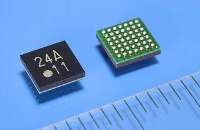
NEC Electronics Corporation (TSE: 6723) and its subsidiary in Europe, NEC Electronics (Europe) GmbH, introduced the µPD161451 bridge IC for 3G mobile handsets, a chip that facilitates development of handsets with rotating high-resolution TFT displays, leveraging the advanced technology of NEC Electronics' Mobile CMADSTM high-speed serial interface.
Recent evolutions in mobile handsets have seen increasing popularity in handset designs with rotating or revolving high resolution thin film transistor (TFT) displays. Compared to previous clamshell designs, the part that connects the display to the main body in these new phones is much narrower, necessitating different design requirements such as a significant reduction in the number of data transmission lines that cross this segment.
The µPD161451 bridge IC has a number of features that help manufacturers implement high-speed serial interfaces in mobile handsets. Compared to standard parallel interfaces, the chip's serial interface can reduce the typical number of image data transmission lines from 18 lines to 4 lines, freeing up valuable real estate in the thin passageway that connects the display to the main body of the phone. The chip itself also has smallest-in-class dimensions of 4mm x 4mm, further contributing to board space. In addition, the Mobile CMADSTM technology enables 128Mbps high-speed data transmission while reducing electromagnetic (EMI) noise by 90% and maintaining low power consumption.
The µPD161451 bridge IC is designed for use in the main body of the mobile handset. When paired with one of NEC Electronics' five LCD driver ICs (installed in the display portion), manufacturers can achieve high-speed serial transmission without modifying their existing baseband LSI or data processing unit. This serial-serial pairing is the first of its kind in the industry.
The bridge IC and driver IC convert parallel signals to serial and transmit the data to a compatible driver IC housed in the TFT LCD display panel.
"Over the past few years we have witnessed an explosion of advanced content for mobile phones such as full-motion graphics, games, and videoconferencing. At the same time there has been a proliferation in mobile handsets designs that require certain design considerations." stated Kazumichi Aoki, General Manager, Display Systems Division, NEC Electronics. "By providing high-speed data transmission while minimizing the power consumption and EMI noise challenges faced by parallel interfaces, we hope to promote Mobile CMADSTM interface as an industry standard."
Pricing and Availability
Samples of the µPD161451 are priced at US$8.00 per unit. Pricing subject to change. Volume production is scheduled to begin January 2005. Monthly production is expected to reach 1 million units.
For specifications of the new products click here.
-
From lemons to lemonade: Reaction uses carbon dioxide to make carbon-based semiconductor,
32 comments
-
Thioridazine kills cancer stem cells in human while avoiding toxic side-effects of conventional cancer treatments,
3 comments
-
SpaceX private rocket blasts off for space station (Update),
42 comments
-
Climate scientists say they have solved riddle of rising sea,
31 comments
-
SpaceX capsule has 'new car' smell, astronauts say (Update),
4 comments
More news stories
Browser wars flare in mobile space
The browser wars are heating up again, but this time the fight is for dominance of the mobile Internet.
17 hours ago |
4 / 5 (4) |
3
Probability of contamination from severe nuclear reactor accidents is higher than expected: study
Catastrophic nuclear accidents such as the core meltdowns in Chernobyl and Fukushima are more likely to happen than previously assumed. Based on the operating hours of all civil nuclear reactors and the number ...
Technology / Energy & Green Tech
May 22, 2012 |
3.6 / 5 (25) |
56
|
HyperSolar shows dirty water no barrier to power world
(Phys.org) -- The Santa Barbara, California, company, HyperSolar, is set to transparently share the ups and downs of its research experiences toward the companys ultimate vision, successfully producing ...
SpotterRF debuts Radar Backpack Kit (w/ Video)
(Phys.org) -- SpotterRF has announced a special radar backpack kit designed to enhance situational awareness for soldiers on the ground. The company says its special radar is designed for warfighters as part ...
Tesla to launch electric sedan in US on June 22
Tesla Motors said Tuesday it would begin deliveries of "the world's first premium electric sedan" on June 22, slightly ahead of schedule.
Technology / Energy & Green Tech
May 22, 2012 |
4.5 / 5 (12) |
18
'Unzipped' carbon nanotubes could help energize fuel cells, batteries
Multi-walled carbon nanotubes riddled with defects and impurities on the outside could replace some of the expensive platinum catalysts used in fuel cells and metal-air batteries, according to scientists at ...
Change in developmental timing was crucial in the evolutionary shift from dinosaurs to birds: study
At first glance, it's hard to see how a common house sparrow and a Tyrannosaurus Rex might have anything in common. After all, one is a bird that weighs less than an ounce, and the other is a dinosaur that ...
Computer model used to pinpoint prime materials for efficient carbon capture
When power plants begin capturing their carbon emissions to reduce greenhouse gases and to most in the electric power industry, it's a question of when, not if it will be an expensive undertaking.
T cells 'hunt' parasites like animal predators seek prey, study shows
By pairing an intimate knowledge of immune-system function with a deep understanding of statistical physics, a cross-disciplinary team at the University of Pennsylvania has arrived at a surprising finding: T cells use a movement ...
Stunning image of smallest possible five-ringed structure
Scientists have created and imaged the smallest possible five-ringed structure about 100,000 times thinner than a human hair and you'll probably recognise its shape.
Land and sea species differ in climate change response: study
(Phys.org) -- Marine and terrestrial species will likely differ in their responses to climate warming, new research by Simon Fraser University and Australia’s University of Tasmania has found.