SMART-1's tribute to Cassini
Jun 20, 2005
SMART-1's tribute to Cassini

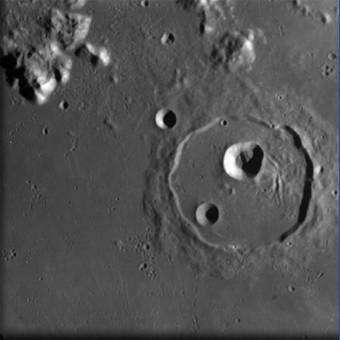
This image from SMART-1 was dedicated to the Cassini-Huygens mission team at the occasion of the European Geoscience Union conference in Vienna, April 2005, when new results from both missions were presented.

Image: Crater Cassini on the Moon, as seen by SMART-1

The crater Cassini on our Moon was named in honour of Jean-Dominique Cassini, one of the most important scientists of the 17th and 18th centuries. The joint NASA/ESA/ASI spacecraft, which is now in orbit around Saturn as part of the Cassini-Huygens mission, bears his name.
This lunar crater has a diameter of 57 km and is located at 40º North on the edge of Mare Imbrium (Sea of Rains). The crater is partly flooded by lava that later filled the large mare basin. The three smaller craters (two inside Cassini and one outside)were formed after the lava flooding.

Mare Imbrium is the second largest basin on the visible side of the Moon, with a diameter of 1250 km, and is one of the youngest of the lunar maria (the youngest is Mare Orientale) at between 3700 and 3900 million years old.

It is surrounded by three concentric rings of mountains, uplifted by the huge impact event that excavated it. Some upland hills are seen here to the north-west of Cassini crater (seen at top left, north is up).

The image was taken with the highly compact, lightweight and rugged AMIE camera on board SMART-1. AMIE stands for the Advanced Moon Micro-Imager Experiment (AMIE) experiment.

AMIE is based on work done by ESA’s Technological Research Programme and developed SPACE-X, Space Exploration Institute, in Neuchatel, Switzerland.

Source: ESA

Explore further: Communications satellite launched into space

add to favorites email to friend print save as pdf

Related Stories

Galaxies fed by funnels of fuel

3 hours ago

(Phys.org) —Computer simulations of galaxies growing over billions of years have revealed a likely scenario for how they feed: a cosmic version of swirly straws.

Google eyes emerging markets networks

3 hours ago

Google has become deeply involved in a series of projects to build and operate wireless networks in emerging markets including sub-Saharan Africa and Southeast Asia, a report said Friday.

Recommended for you

Galaxies fed by funnels of fuel

May 24, 2013

(Phys.org) —Computer simulations of galaxies growing over billions of years have revealed a likely scenario for how they feed: a cosmic version of swirly straws.

Dark, massive asteroid to fly by Earth on May 31

May 24, 2013

It's 1.7 miles long. Its surface is covered in a sticky black substance similar to the gunk at the bottom of a barbecue. If it impacted Earth it would probably result in global extinction. Good thing it is ...

Source of life running out: water scientists

May 24, 2013

The majority of people on Earth people will face severe water shortages within a generation or two if pollution and waste continues unabated, scientists warned at a conference in Bonn Friday.

Research team explains 'Lazarus' comets

May 24, 2013

Astronomers from the University of Antioquia have discovered a graveyard of comets. These once-dormant comets, dubbed by astronomers as "The Lazarus comets," are now rejuvenated.

User comments : 0

More news stories

Galaxies fed by funnels of fuel

(Phys.org) —Computer simulations of galaxies growing over billions of years have revealed a likely scenario for how they feed: a cosmic version of swirly straws.