NASA's CloudSat Spacecraft Arrives at Launch Site
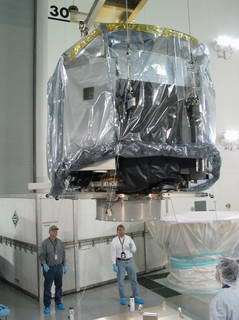
A NASA spacecraft designed to reveal the inner secrets of Earth's clouds has arrived at Vandenberg Air Force Base, Calif., to begin final launch preparations.
The CloudSat spacecraft arrived at Vandenberg from Ball Aerospace & Technologies Corp., Boulder, Colo., on May 2. Following final tests, it will be integrated onto a Boeing Delta II launch vehicle, sharing its ride into orbit later this year with another NASA spacecraft, the Cloud-Aerosol Lidar and Infrared Pathfinder Satellite Observation, or Calipso.
CloudSat and Calipso will give us new, 3-D perspectives on Earth's clouds and aerosols that will answer questions about how they form, evolve and affect our weather, climate, water supply and air quality.
CloudSat and Calipso employ revolutionary measurement technologies that will probe Earth's atmosphere as never before. Each spacecraft transmits pulses of electromagnetic energy and measures the portion scattered back to the instruments. CloudSat's Cloud Profiling Radar is more than 1,000 times more sensitive than typical weather radar. Calipso's polarization lidar instrument can tell the difference between ice and water in clouds, and between liquid and solid aerosol particles. By distinguishing aerosols from ice particles based on combined Calipso and CloudSat data, we will gain new═insight into dynamics and properties of clouds and their influence on Earth's radiation balance.
The satellites will be launched into a 705-kilometer (438-mile) circular, Sun-synchronous polar orbit, where they will fly just 15 seconds apart as part of NASA's ⌠A-Train■ constellation of three other Earth Observing System satellites.
The usefulness of data from CloudSat, Calipso and the other satellites of the A-train will be much greater when combined. The data will help scientists better understand how sources of local pollution affect air quality, and will improve weather forecasting and climate prediction.
The other three Earth Observing System satellites that make up NASA's A-Train are: NASA's Aqua spacecraft; NASA's Aura spacecraft; and the French Space Agency's (Centre National d'Etudes Spatiales) Polarization and Anisotropy of Reflectances for Atmospheric Sciences coupled with Observations from a Lidar, or Parasol, spacecraft.
CloudSat is an international and interagency mission with project management by NASA's Jet Propulsion Laboratory, Pasadena, Calif. The CloudSat radar instrument was developed at JPL with hardware contributions from the Canadian Space Agency. Colorado State University provides scientific leadership and science data processing. Other contributions include the U.S. Air Force (satellite on-orbit operations control) and the U.S. Department of Energy (scientific contributions). Ball Aerospace & Technologies Corp. designed and built the spacecraft.
Calipso is being developed through collaboration between NASA and France's Centre National d'Etudes Spatiales. NASA's Langley Research Center, Hampton, Va., is leading the Calipso mission and is providing overall project management, systems engineering, payload mission operations, and validation, processing and archiving of data. NASA's Goddard Space Flight Center, Greenbelt, Md., is providing project management and system engineering support, and overall program management for the mission. Centre National d'Etudes Spatiales is providing a Proteus spacecraft developed by Alcatel, the imaging infrared radiometer, payload-to-spacecraft integration, and spacecraft mission operations. The Institut Perre Simon Laplace in Paris, France, is providing the imaging infrared radiometer science oversight, data validation and archiving. Hampton University, Hampton, Va., is providing scientific contributions and managing the outreach program. Ball Aerospace & Technologies Corp. developed the lidar and on-board visible camera.
Source: NASA


