Prospecting for oil, and life on Mars
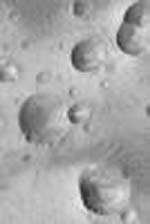
Techniques usually used to find oil and gas in the North Sea could help scientists establish whether life could survive on Mars
The surface of Mars is covered with craters, caused by crashing meteorites. It was first feared that the damage caused could have made the Red Planet uninhabitable, and that all traces of previous life could have been destroyed.
However, using techniques normally deployed by the oil industry to predict oil and gas deep beneath the surface, Professor John Parnell at the University of Aberdeen has shown that the rocks in a terrestrial crater were not heated so greatly that all evidence of past life would be obliterated, and in fact some microbial life may even have survived the impact.
Scientists have discovered that the crater has retained traces of ancient organic matter that can still be detected millions of years after the fiery crash of a space rock.
Professor Parnell is part of an international team working on the Haughton meteorite impact site in the Canadian High Arctic. He explained: “Working in this remote uninhabited terrain gives us a great opportunity to do detailed sampling where the rocks have not been contaminated by man or covered by vegetation. However, the snow and ice are only melted for a few weeks each year, so we just have a brief window when the work has to be completed.”
The crater is the subject of a NASA project, under the leadership of Pascal Lee of the Mars Institute and NASA Ames Research Center, who co-ordinates scientific and technological research which can be applied to future exploration on Mars. Another British scientist, Gordon Osinski, currently of the Canadian Space Agency, mapped the crater in detail and collected the samples analysed at Aberdeen.
Paul Green of Geotrack International, a company with a long record of servicing the oil industry, then modelled the data. The results show that the 24km wide crater experienced heating by circulating hot water for about 5,000 years after impact, mostly at temperatures below 150ºC. This is cooler than some oilfields, so there is no question of widespread destruction of organic remains. On the contrary, the heated waters may have discharged at the crater surface as hot springs, and this is just the kind of site envisaged by some scientists as suitable for the emergence of life.
“It is widely believed that frequent impact events on the early Earth destroyed organic matter and inhibited evolution. However, the Haughton data suggests that in moderate-sized craters, biomolecules, fossilized remains and even microbial life may have survived,” added Professor Parnell.
These findings, reported in the May edition of the leading journal ‘Geology’, published by the Geological Society of America, will encourage the growing momentum of scientific investigation to seek evidence of life beyond the Earth.
This is one of many ways in which expertise developed for oil exploration can be directed at the exploration of Mars. The recent discovery of methane (natural gas) in the Martian atmosphere by the European Mars Express orbiting spacecraft is an intriguing observation that invites us to apply the thinking of the oilman to the search for life on Mars.
Professor Parnell is part of a team that was awarded a £400,000 grant from the UK’s Engineering and Physical Sciences Research Council Research in 2003 to create new ways to pinpoint evidence of the earliest inklings of life on Earth, billions of years before plants and animals first became extensively preserved in the planet’s fossil record.
“If the technology proves successful,” he said at the time, “it will enable us to take advantage of a new source of information about the history of life on Earth, and potentially on other planets too. The project is highly innovative, attempting to access a source of biomolecules that has not been tapped before and could significantly enhance our knowledge of the development of life on Earth.”
Source: University of Aberdeen


