Prospecting for Lunar Water
by Patrick L. Barry
The next time you look at the Moon, pause for a moment and let this thought sink in: People have actually walked on the Moon, and right now the wheels are in motion to send people there again.
The goals this time around are more ambitious than they were in the days of the Apollo program. NASA's new Vision for Space Exploration spells out a long-term strategy of returning to the Moon as a step toward Mars and beyond. The Moon, so nearby and accessible, is a great place to try out new technologies critical to living on alien worlds before venturing across the solar system.
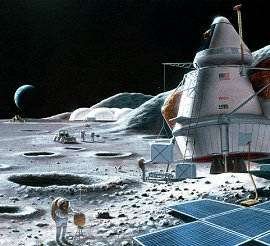
Image: NASA is gearing up to send humans back to the Moon. NASA artwork by Pat Rawlings / SAIC.
Whether a moonbase will turn out to be feasible hinges largely on the question of water. Colonists need water to drink. They need water to grow plants. They can also break water apart to make air (oxygen) and rocket fuel (oxygen+hydrogen). Furthermore, water is surprisingly effective at blocking space radiation. Surrounding the 'base with a few feet of water would help protect explorers from solar flares and cosmic rays.
The problem is, water is dense and heavy. Carrying large amounts of it from Earth to the Moon would be expensive. Settling the Moon would be so much easier if water were already there.
It's possible: Astronomers believe that comets and asteroids hitting the Moon eons ago left some water behind. (Earth may have received its water in the same way.) Water on the Moon doesn't last long. It evaporates in sunlight and drifts off into space. Only in the shadows of deep cold craters could you expect to find any, frozen and hidden. And indeed there may be deposits of ice in such places. In the 1990s two spacecraft, Lunar Prospector and Clementine, found tantalizing signs of ice in shadowed craters near the Moon's poles--perhaps as much as much as a cubic kilometer. The data were not conclusive, though.
To find out if lunar ice is truly there, NASA plans to send a robotic scout. The Lunar Reconnaissance Orbiter, or "LRO" for short, is scheduled to launch in 2008 and to orbit the Moon for a year or more. Carrying six different scientific instruments, LRO will map the lunar environment in greater detail than ever before.
"This is the first in a string of missions," says Gordon Chin, project scientist for LRO at NASA's Goddard Space Flight Center. "More robots will follow, about one per year, leading up to manned flight" no later than 2020.
LRO's instruments will do many things: they'll map and photograph the Moon in detail, sample its radiation environment and, not least, hunt for water.
For example, the spacecraft's Lyman-Alpha Mapping Project (LAMP), will attempt to peer into the darkness of permanently shadowed craters at the Moon's poles, looking for signs of ice hiding there.
How can LAMP see in the dark? By looking for the dim glow of reflected starlight.
LAMP senses a special range of ultraviolet light wavelengths. Not only is starlight relatively bright in this range, but also the hydrogen gas that permeates the universe radiates in this range as well. To LAMP's sensor, space itself is literally aglow in all directions. This ambient lighting may be enough to see what lies in the inky blackness of these craters.
"What's more, water ice has a characteristic spectral 'fingerprint' in this same range of ultraviolet light, so we'll get spectral evidence of whether ice is in these craters," explains Alan Stern, a scientist at the Southwest Research Institute in Boulder, Colorado, and principal investigator for LAMP.
The spacecraft is also equipped with a laser that can shine pulses of light into dark craters. The main purpose of the instrument, called the Lunar Orbiter Laser Altimeter (LOLA), is to produce a highly accurate contour map of the entire Moon. As a bonus, it will also measure the brightness of each laser reflection. If the soil contains ice crystals, as little as 4%, the returning pulse would be noticeably brighter.
LOLA by itself can't prove that ice is there. "Any kind of reflective crystals could produce brighter pulses," explains David Smith, principal investigator for LOLA at NASA's Goddard Space Flight Center. "But if we see brighter pulses only in these permanent shadows, we'd strongly suspect ice."
One of LRO's instruments, named Diviner, will map the temperature of the Moon's surface. Scientists can use these measurements to search for places where ice could exist. Even in the permanent shadows of polar craters, temperatures must be very low for ice to resist evaporation. Thus, Diviner will provide a "reality check" for LRO's other ice-sensitive instruments, identifying areas where positive signs of ice would not make any sense because the temperature is simply too high.
Another reality check will come from LRO's Lunar Exploration Neutron Detector (LEND), which counts neutrons spraying out of the lunar surface. Why does the Moon emit neutrons? And what does that have to do with water? The Moon is constantly bombarded by cosmic rays, which produce neutrons when they hit the ground. Hydrogen-bearing compounds like H2O absorb neutrons, so a dip in neutron radiation could signal an oasis ... of sorts. LEND is being developed by Igor Mitrofanov from the Institute for Space Research, Federal Space Agency, Moscow.
"There's a strong synergy between the various instruments on LRO," notes Chin. "None of these instruments alone could provide definitive evidence of ice on the Moon, but if they all point to ice in the same area, that would be compelling."
Chin also points out another reason that finding ice near the Moon's poles would be exciting:
Not far from some permanently shadowed craters are mountainous regions in permanent sunlight, known romantically as "peaks of eternal sunshine." Conceivably, a moonbase could be placed on one of those peaks, providing astronauts with constant solar power--not far from crater-valleys below, rich in ice and ready to be mined.
Wishful thinking? Or a reasonable plan? Lunar Reconnaissance Orbiter will beam back the answer.
Source: Science@NASA (by Patrick L. Barry)


