Chip-scale refrigerators cool bulk objects
Chip-scale refrigerators capable of reaching temperatures as low as 100 milliKelvin have been used to cool bulk objects for the first time, researchers at the National Institute of Standards and Technology (NIST) report. The solid-state refrigerators have applications such as cooling cryogenic sensors in highly sensitive instruments for semiconductor defect analysis and astronomical research.
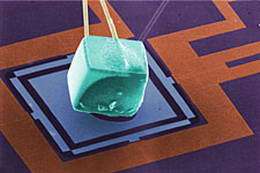
Image: This colorized scanning electron micrograph shows a cube of germanium attached to a membrane. The four small light blue rectangles at the midpoints of the membrane perimeter are chip-scale refrigerators that cooled the cube and membrane to only a few hundred thousandths of a degree above absolute zero.
Image credit: N. Miller, A. Clark/NIST
The work is featured in the April 25, 2005, issue of Applied Physics Letters.* The NIST-designed refrigerators, each 25 by 15 micrometers, are sandwiches of a normal metal, an insulator and a superconducting metal. When a voltage is applied across the sandwich, the hottest electrons "tunnel" from the normal metal through the insulator to the superconductor. The temperature in the normal metal drops dramatically and drains electronic and vibrational energy from the objects being cooled.
The researchers used four pairs of these sandwiches to cool the contents of a silicon nitrate membrane that was 450 micrometers on a side and 0.4 micrometers thick. A cube of germanium 250 micrometers on a side was glued on top of the membrane. The cube is about 11,000 times larger than the combined volume of the refrigerators. This is roughly equivalent to having a refrigerator the size of a person cool an object the size of the Statue of Liberty. Both objects were cooled down to about 200 mK, and further improvements in refrigerator performance are possible, according to the paper.
The refrigerators are fabricated using common chip-making lithography methods, making production and integration with other microscale devices straightforward. The devices are much smaller and less expensive than conventional equipment used for cooling down to 100 mK, a target temperature for optimizing the performance of cryogenic sensors. These sensors take advantage of unusual phenomena that occur at very low temperatures to detect very small differences in X-rays given off by nanometer-scale particles, enabling users such as the semiconductor industry to identify the particles. The work was supported in part by the National Aeronautics and Space Administration and NIST's Office of Microelectronics Programs.
*A.M. Clark, N.A. Miller, A. Williams, S.T. Ruggiero, G.C. Hilton, L.R. Vale, J.A. Beall, K.D. Irwin, J.N. Ullom. Cooling of Bulk Material by Electron-Tunneling Refrigerators. Applied Physics Letters. April 25, 2005.
Source: National Institute of Standards and Technology (NIST)


